

 1 hour ago
5
1 hour ago
5
ARTICLE AD BOX

A surprising number of individuals grapple with chronic headaches, even when their medical exams return normal. Health professionals point to lifestyle elements that might be sliding under the radar. Stress levels, improper sitting habits, and the relentless hours in front of screens are all key players in this headache saga.
A clear MRI. Normal blood work. No visible red flags. But the headache keeps returning, interrupting daily life. This is a story many people are living today. It feels confusing because medicine says everything is fine, but the body tells a different truth.Frequent headaches with normal reports are not rare. In fact, they can point to something more subtle, patterns, habits, and daily imbalances that don’t show up on scans. The real concern is not just the pain, but the fact that these headaches are signals being missed.
Watch
Easy home remedies to get rid of headaches
The hidden trigger doctors say we overlook
Doctors are now pointing towards something less dramatic but far more common: lifestyle-driven triggers.Dr B K Madhusudhan explains, “People experience frustrating headaches which medical tests show no evidence of because their hidden lifestyle factors and functional triggers cause their headaches.”Dr Praveen Gupta adds, “Many people continue to suffer from frequent headaches despite having completely normal reports, and this can be both confusing and frustrating… the root issue is often functional rather than structural.”This shifts the focus. The problem is not always in the brain’s structure. It often lies in how the brain is being used and stressed every day.

Chronic stress, poor posture, excessive screen time, irregular meals, dehydration, and disturbed sleep patterns play a major role.
Stress, posture, and screen time: the silent trio
Modern life has quietly built a perfect storm for headaches.
Stress sits at the centre. It tightens scalp and neck muscles, leading to what doctors call tension headaches. These are not dramatic, but they linger and return.Then comes posture. Hours spent bent over laptops or phones strain the neck and shoulders. Over time, this strain travels upward and settles as pain in the head.Add screen time, and the effect deepens. Reduced blinking and constant focus increase eye pressure.
The result is a dull, persistent headache that feels hard to explain.A government-backed resource like the National Health Portal of India highlights how prolonged screen exposure and poor ergonomics are emerging contributors to headaches and eye strain.
When food and sleep quietly go wrong
Headaches are not always about what is happening in the head. Sometimes, they begin in the stomach or the sleep cycle.Skipping meals lowers blood sugar. This leads to fatigue, irritability, and eventually head pain.
Irregular eating patterns disturb the body’s rhythm, making headaches more frequent.Sleep plays an equally strong role. Too little sleep, broken sleep, or even oversleeping can trigger headaches.As Dr Madhusudhan notes, “Meal skipping results in decreased blood sugar levels which subsequently causes people to experience both exhaustion and head pain.”Research supported by bodies like the Indian Council of Medical Research also points to lifestyle and metabolic factors influencing neurological symptoms, including headaches.
Why normal reports don’t mean “no problem”
Most routine medical tests look for structural issues, tumours, infections, or major neurological conditions. But they don’t measure daily habits.They cannot track:
- how long someone sits without moving
- how often meals are skipped
- how much stress is carried silently
- how hydration fluctuates through the day
That is why these headaches often fall into a “functional” category. The body is reacting, but not in a way machines can easily detect.Dr Praveen Gupta explains it clearly, “Patients tend to focus on serious neurological causes, but in reality, the root issue is often functional rather than structural.”This gap is where many people feel stuck, medically “fine,” but physically uncomfortable.
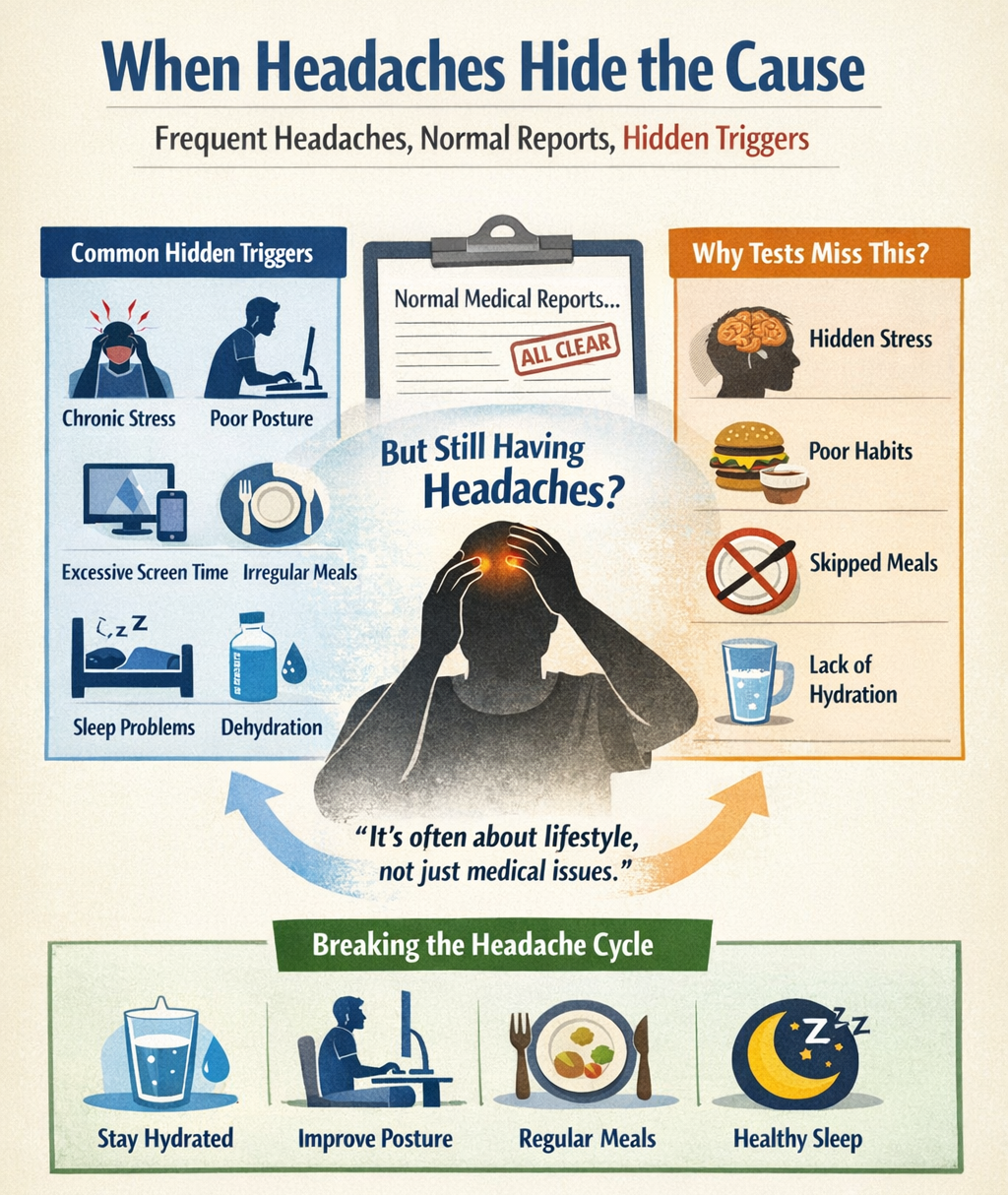
Doctors emphasise that small, consistent lifestyle changes can significantly reduce headache frequency and intensity.
Small changes that can quietly break the cycle
The good news is that these headaches often respond well to simple, consistent changes. Not overnight fixes, but steady shifts.Hydration is one of the easiest starting points. Even mild dehydration can trigger headaches.Posture correction matters more than it seems. Sitting upright, adjusting screen height, and taking short breaks can reduce strain.Regular meals stabilise blood sugar. Even small, balanced meals at fixed times can make a difference.Sleep hygiene, going to bed and waking up at the same time, helps reset the body’s rhythm.As Dr Gupta puts it, “Identifying these hidden triggers and making small but consistent lifestyle changes… can significantly reduce the frequency and intensity of headaches without the need for heavy medication.”
Listening to what the body is trying to say
Frequent headaches are not always a sign of something dangerous, but ignoring them can allow patterns to deepen.The body often whispers before it shouts. A recurring headache, especially with normal reports, is one such whisper. It asks for attention, not panic, but awareness.Understanding this changes the approach. Instead of chasing a diagnosis alone, it becomes important to observe daily life. Patterns begin to reveal themselves slowly, and once they do, relief often follows.Medical experts consultedThis article includes expert inputs shared with TOI Health by:Dr Praveen Gupta, Chairman - Marengo Asia International Institute of Neuro & Spine (MAIINS), Gurugram.Dr B K Madhusudhan, Lead Consultant – Neurology, Aster RV Hospital, Bangalore.Inputs were used to explain why frequent headaches can persist despite normal reports, identify overlooked triggers that may be responsible, and highlight the importance of proper evaluation and targeted management.









 English (US) ·