

 1 hour ago
7
1 hour ago
7
ARTICLE AD BOX
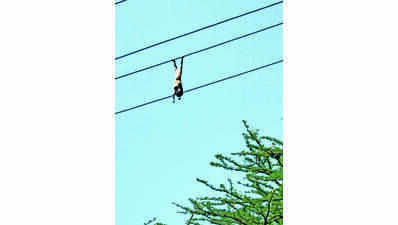
The photo that environmental activist Bharathidasan took of a slender loris that was electrocuted
In March, Tamil Nadu established India’s first slender loris conservation centre at Kadavur. But it was a chance photograph and post by environmental activist S Bharathidasan that turned out to be a real lifesaver for the nocturnal primate.Around two months ago, Bharathidasan was passing through Dindigul to his hometown when he spotted a slender loris electrocuted in the bare overhead wires. He clicked a photo and posted it online, which was picked up by a few media outlets. The incident was thus noticed by many, including a Madurai-based advocate, Pushpavanam, who filed a public interest litigation (PIL) at the Madurai bench of the Madurai high court.
This, says Bharathidasan, has resulted in an interim order directing authorities to replace all bare overhead high-tension wires passing around and through the Kadavur slender loris sanctuary with insulated cables.“Insulation of electric lines and the use of aerial bundled cables is being pursued in critical loris habitats to prevent electrocution during tree-to-tree movement,” says Supriya Sahu, additional chief secretary for the environment, climate change, and forests department. “Coordination with the Tamil Nadu Electricity Board is underway for the phased replacement of vulnerable lines.
As this is a relatively high-cost intervention, implementation will be taken up in phases.”“The area where I spotted the animal is a highway, which is why I noticed it. For miles around it’s farmland, with electric cables criss-crossing the area, where the deaths go unnoticed,” says Bharathidasan, founder of the nature conservation organisation ‘Arulagam’.Electrocutions are unfortunately common, says R Sasi, Salim Ali Centre for Ornithology and Natural History researcher in slender loris behaviour and ecology.
“Dindigul, Madurai and Trichy are loris landscapes. Lorises walk through trees, grabbing branches, and can’t jump across like monkeys. In the process they come into contact with wires.” Primarily insectivores, slender loris are shy animals who turn active during the late evenings and nights.
The animals are of help to farmers as they consume pests.Besides insulation, the use of red reflective road markings and warning signage in loris habitats is being planned to encourage motorists to slow down and exercise caution, says Sahu.
“Awareness programmes for local communities, schools and road users have begun through the conservation centre. An eco-development committee comprising local villagers has been formed to strengthen community participation in conservation efforts.
”Additional measures being explored to further reduce mortality include installing canopy or rope bridges across roads and gaps in forest cover, maintaining continuous tree canopy along movement routes, and promoting native roadside tree planting to reconnect fragmented habitats.
“With regard to road safety, we are declaring identified stretches as loris slow zones,” she adds. Transformers and exposed junction points will be insulated.
Hazardous poles will be retrofitted and periodic audits conducted of electrocution hotspots. Loris crossing hotspots will be mapped using camera traps and citizen reporting. A district-level slender loris conservation action plan will be developed to guide future interventions.”






 English (US) ·