

 1 week ago
8
1 week ago
8
ARTICLE AD BOX
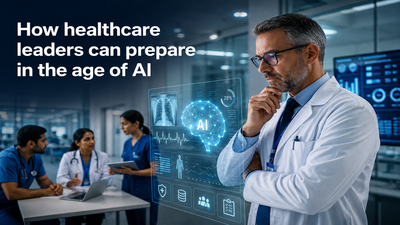
Artificial Intelligence is actively reshaping the global medical landscape. From automating administrative tasks to assisting in complex clinical decisions, AI is driving unprecedented efficiency and precision.
According to a 2026 Grand View Research report1, the global AI in healthcare market is projected to grow from USD 50.7 billion in 2026 to over USD 505.6 billion by 2033, at a CAGR of 38.9%. As AI becomes increasingly embedded across diagnostics, clinical decision support, hospital operations, and patient engagement, organisations are seeking professionals who can evaluate, govern, and implement these technologies responsibly.Why do professionals in healthcare need AI skills in 2026? Professionals in healthcare need AI skills in 2026 because AI is rapidly transforming how care is delivered, managed, and optimised. From diagnostics, imaging, and predictive analytics to patient engagement and hospital operations, AI-powered tools are becoming integral to healthcare systems. To use these technologies responsibly and effectively, healthcare professionals need the skills to assess AI solutions, guide implementation, mitigate risks, and ensure ethical, patient-centered outcomes.Acquiring AI skills allows professionals to move beyond basic AI literacy and step into high-impact strategic roles.Key roles and responsibilities post-acquiring AI skills:
- AI governance: Establishing ethical frameworks, evaluating algorithmic bias, and ensuring compliance with privacy laws like HIPAA.
- Clinical workflow optimisation: Auditing and redesigning hospital operations to seamlessly integrate AI-assisted triage, predictive analytics, and automated reporting.
- Technology evaluation: Guiding procurement by assessing the clinical validity, safety, and ROI of third-party AI tools.
- Change management leadership: Bridging the gap between data scientists and frontline clinical staff, driving smooth organisational adoption of new digital solutions.
As these advanced technologies move from experimental pilot projects into everyday operations, Healthcare systems are facing a critical turning point. It is no longer a question of whether to adopt AI, but who inside the organisation possesses the framework and knowledge to govern it safely and ethically. Offered in collaboration with Great Learning, the AI in Healthcare Program by Johns Hopkins University is designed to address this emerging leadership and governance gap. Why Johns Hopkins University stands apartWhen it comes to healthcare AI, credibility matters. Johns Hopkins University brings together world-class expertise in medicine, engineering, and research to help professionals navigate one of healthcare's most significant technological shifts.
Johns Hopkins University is at the forefront of advancing AI-powered healthcare innovation. Through its research-driven and interdisciplinary approach, the university continues to explore how AI can improve patient care, clinical decision-making, and healthcare operations, making it uniquely positioned to prepare healthcare professionals for an AI-enabled future.To address the growing leadership gap, the university offers the AI in Healthcare program.Inside the JHU AI in Healthcare Program: Core curriculum and who is it forThe curriculum is specifically designed for professionals in the healthcare industry, including medical researchers, pharmaceutical researchers, biotech researchers, clinicians, hospital administrators, healthcare policymakers, consultants, regulators, and business leaders in healthtech. Instead of teaching Python or heavy coding, the program focuses strictly on strategic application, risk mitigation, and the specialised R.O.A.D.
Management Framework (Recognise, Orchestrate, Adopt, and Drive AI solutions).This program offers a blend of recorded video lectures, weekly interactive mentored sessions by industry experts, and live masterclasses by JHU faculty. They will also learn from real-world examples through 8+ practical healthcare case studies covering applications of AI in disease prediction, clinical workflows, and personalised patient care.Highlighting the vision behind this curriculum, Paul Huckett, Associate Dean, Johns Hopkins Engineering Executive and Professional Education, said:“We believe the future of healthcare will be shaped by how effectively emerging technologies like AI are adopted. The AI in Healthcare program is designed not just to teach technical skills but also to cultivate leaders who can leverage AI to transform patient care, strengthen health systems, and drive innovation responsibly.
Through this collaboration with Great Learning, we are creating a bridge between academic knowledge and real-world application.
”Real impact: Learner experiencesThe true value of the program is reflected in the experiences of its cohort, which bridges the gap between frontline clinical research, biochemistry, and public health implementation."The program bridged the gap between theory and real-world healthcare applications and strengthened my interest in AI-driven healthcare solutions for early risk detection and scalable health interventions. I see immense potential in leveraging Artificial Intelligence for early risk detection and scalable health interventions." — Babitha Rajan, Doctor, M.S. Ramaiah Medical College"I truly appreciated the emphasis on evidence-based AI integration. This approach moves away from endless pilot projects toward safe, proven interventions across healthcare." — Jeanne Coetzee, Clinical Research Physician, Wits RHIHow will the program help you build AI capabilities for healthcare?The program equips professionals in healthcare with the knowledge and frameworks needed to evaluate, govern, and implement AI solutions across clinical and operational settings.
Through a curriculum focused on AI fundamentals, clinical decision support, population health, healthcare strategy, ethics, and change management, learners develop the skills to lead AI initiatives responsibly and effectively.Upon successful completion of the program, learners receive a Certificate of Completion and six Continuing Education Units (CEUs) from Johns Hopkins University. More importantly, they gain the confidence to assess emerging AI technologies, guide organisational adoption, and contribute to better patient outcomes in an increasingly AI-enabled healthcare ecosystem.Reference1. https://www.grandviewresearch.com/industry-analysis/artificial-intelligence-ai-healthcare-marketDisclaimer: This article has been produced on behalf of Great Learning by Times Internet’s Spotlight team.







 English (US) ·