

 1 hour ago
3
1 hour ago
3
ARTICLE AD BOX
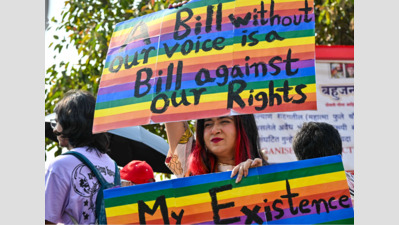
HEAR OUR VOICE: Members of the LGBTQ+ community held protests across the country demanding that the Transgender (Amendment) Bill 2026 be withdrawn
N Kavitha RameshwarThe Transgender Persons (Protection of Rights) Amendment Bill, 2026, passed by Parliament on March 25, raises issues well beyond the rights of transgender persons. It involves, to begin with, crucial questions relating to the supremacy of the Constitution and the majesty of the Supreme Court as the final interpreter of constitutional provisions, in general as well as vis-à-vis the rights of citizens. The law does not just seek to dilute the rights of transgender people and the LGBTQ+ community hitherto guaranteed and protected both by courts and legislation, but seeks to be that one rogue wave that will wash away the entire edifice of constitutional jurisprudence created over a decade in the arena of transgender rights, as if it were all but a castle of sand. What is even more significant is the manner in which hundreds of pages articulating progressive thought in judicial decisions have been reversed by changing the very definition of ‘transgender persons’.
While the focal point of transgender rights is self-perceived gender identity and the right to self-determination, approved with authority by Supreme Court in the 2014 NALSA judgment, which officially recognised transgender people as a “third gender”. The binding precedent had ushered in the passing of the Transgenders (Protection of Rights) Act, 2019, which defined transgender persons expansively. The new law changes the face of such rights by removing the factor of self-determination.
The Act defines ‘transgender persons’ as those whose gender does not match with the one assigned at birth, and specifies certain categories of persons were included, limiting them not only to persons with variations at birth in primary sexual characteristics, external genitalia, chromosomes, or hormones from the normative standard of male or female body, but also persons with sociocultural identity such as kinner, hijra, aravani and jogta. The new law only lists the categories of people to be included, removing the definition as stated in the Act, as also categories such as trans-man or trans-woman, irrespective of whether such a person had undergone sex reassignment surgery, hormone therapy, laser therapy or such other therapy and also gender queer persons.More importantly and rather shockingly, the proviso to the definition of ‘transgender persons’ in the new law states that it will not include nor shall ever have included persons with different sexual orientations and self-perceived sexual identities. With this, the Act of 2019 and the very foundational block of all judgments have been set at naught — from NALSA, the Navtej Singh Johar case in 2018 (when SC decriminalised all consensual sex among adults, including homosexual sex), to the Jane Kaushik case in 2025 (where SC ruled that discrimination based on gender identity is illegal). SC had in Jane Kaushik, adopted a hortatory approach, making plain its dissatisfaction and ire at the state’s nonchalance in implementing the provisions of the 2019 Act proactively to ensure the translation of the letter and spirit of the legislation into reality in the lives of transgender people.
The law now presented, is an affront to a section of its citizens who are second to none but continuously being at the receiving end of treatment as secondary citizens, not only discriminated against historically but also in the present, making them a ‘suspect class’ deserving more conscious protection.The new law does not seek to amend the provisions of the 2019 Act but to amend its object, purpose and intention and thus leave it as an eviscerated piece of legislation, whose existence will matter little to anyone for whose benefit it was enacted. The next significant change sought to be brought in by the law is the vesting of power in the medical board, on whose recommendation alone the district magistrate will issue a certificate of identity to the applicant. This provision, which is an offshoot of the changed definition that does away with self-perceived identity and determination, is rubbing salt in the wound by constituting a direct attack on the privacy and dignity of the individual, all of which have long been elevated as fundamental rights. Here again, the new law is in complete oblivion of the dense literature on the struggles and problems of transgender individuals and the LGBTQ+ community, whose identities have a wide range of varieties.Gender identity is a complex thing, not necessarily to be decided clinically based on primary sexual characteristics or external genitalia. The court has made this clear as daylight when it held that gender identity and biological attributes are distinct concepts, which may not always converge.
This also explains why gender queer persons, who depend heavily on self-determination, and who have now been excluded from the definition of transgender persons in the new law, will face tremendous difficulty in passing the stages of administrative approval for certification of their identity. Apart from dealing fatal blows to the continuance of a dignified life for transgender people and the LGBTQ+, the new law makes one ponder on the why and the how of its coming about. Why did a law of such sweeping retrograde change come in at a time when it took years of struggle to reach where we are, and still not anywhere close to the destination? How did the law in its present form come to be finalised without any consultation with stakeholders, more so in the glare of pronouncements of Supreme Court, bringing the right of self-perceived identity and determination under the gamut of rights guaranteed under Articles 14, 15, 16, 19 and 21 of the Constitution. This makes the new law fly in the face of the “nothing about us, without us” principle, incorporated in disability policymaking, and which applies with equal force to the transgender community.In matters such as these, when the provisions are in flagrant violation of the settled position of law, the presumption of constitutionality of the statute will be at its lowest. The courts will have to subject the amendment to the highest judicial scrutiny to protect the fundamental rights of its citizens, as done in Anuj Garg, where Supreme Court stated that in cases involving violations of fundamental rights, or suspect classifications, what needs to be demonstrated is ‘compelling state interest’, and not just ‘rational nexus’. Neither will the principle of ‘proportionality’, by adopting the ‘least restrictive choice’, save such amendments that undo the rights recognised by the court as inbuilt in fundamental rights. Once again, the people will look to the Constitution and the court as the last resort to reinforce and protect their inherent rights of dignity, equality, and life itself.
|
(The writer is an advocate at Madras high court & Supreme Court)








 English (US) ·