

 58 minutes ago
2
58 minutes ago
2
ARTICLE AD BOX
Last Updated:May 14, 2026, 14:11 IST
The IUML’s organisational and political weight played a major role in Congress choosing VD Satheesan as Kerala Chief Minister.


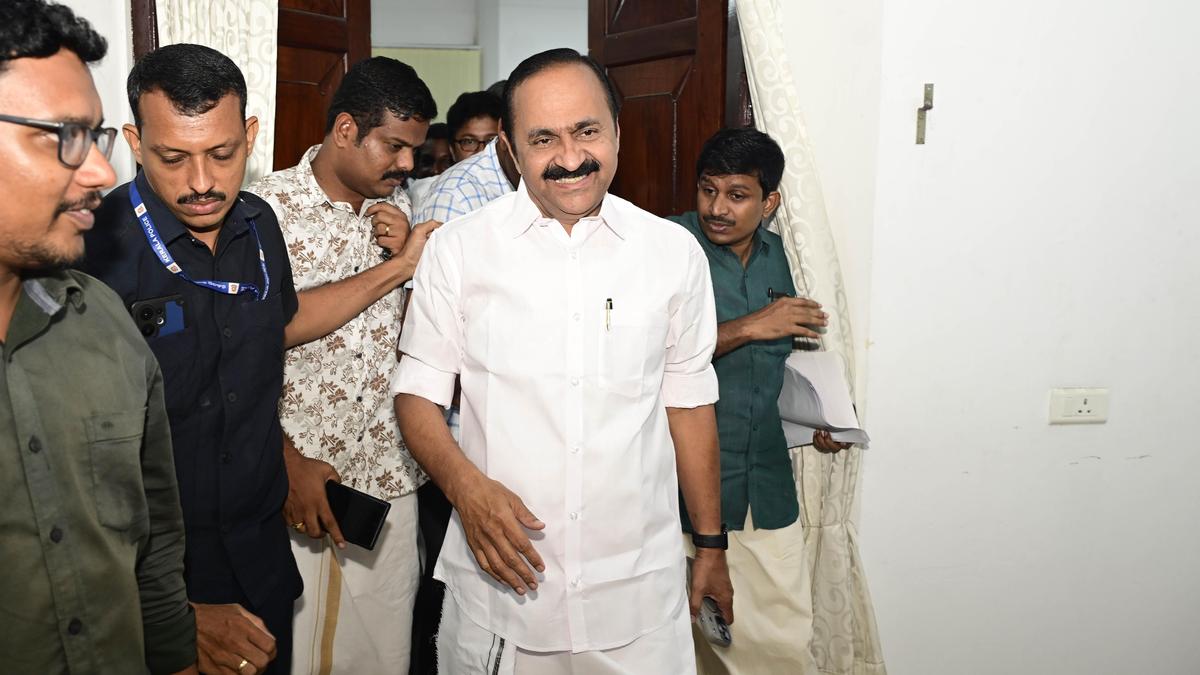
A file photo of VD Satheesan (PTI)
The Congress on Thursday announced VD Satheesan as Kerala’s Chief Minister, 11 days after the Assembly election results were declared on May 4, ending days of suspense, lobbying and visible factional tension within the party.
Even before the official announcement, the leadership tussle between Satheesan and AICC general secretary (organisation) KC Venugopal had triggered intense reactions within the Congress-led United Democratic Front (UDF), especially from the Indian Union Muslim League (IUML), which firmly backed Satheesan from the beginning.
The BJP also targeted the Congress over the delay and the eventual choice of Satheesan.
BJP Kerala posted on X that the Congress and the Gandhi family “cannot survive in Kerala or protect Wayanad without the Indian Union Muslim League", adding that Satheesan becoming CM was “a clear sign that Congress and Gandhis have ultimately bowed down to the IUML".
BJP spokesperson Shehzad Poonawalla also attacked the Congress leadership, claiming the decision came under “two pressures" — “pressure of Jamat and IUML and Muslim votebank" and “pressure of Priyanka Vadra who did not want Rahul’s candidate KC Venugopal at any cost".
So after 11 days Congress has finally announced V D Satheesan as it’s CM faceBut this has been done under two pressures
1) Pressure of Jamat and IUML and Muslim Votebank
2) Pressure of Priyanka Vadra who did not want Rahul’s candidate KC Venugopal at any cost pic.twitter.com/TXGaufE0hP
— Shehzad Jai Hind (Chowkidar as per INC ecosystem) (@Shehzad_Ind) May 14, 2026
Why Did IUML Back Satheesan So Firmly?
The IUML, which won 22 of the 27 seats it contested in the 2026 Assembly election (its highest-ever tally), privately threw its weight behind Satheesan during the prolonged leadership deadlock. Since Venugopal did not share a particularly cordial relationship with the IUML, Satheesan gained an advantage on this front as well.
Senior IUML leader PK Kunhalikutty made it clear after a party leadership meeting that the League stood firmly with Satheesan. The IUML’s argument was that UDF’s massive victory was fundamentally tied to Satheesan’s leadership as Opposition leader over the last five years.
Replacing him after the win, allies feared, could alienate both cadre workers and voters who associated the victory with Satheesan’s campaign against the Left government.
The support was not limited to the IUML. Other UDF allies, such as Kerala Congress (Joseph) and the RSP, also reportedly rallied behind Satheesan. But the IUML’s backing carried particular weight because of its organisational depth and electoral significance.
Why Congress Could Not Ignore IUML
A government could not be formed without the backing of the IUML.
With 22 MLAs in the 102-member UDF camp, the League is not merely a junior ally. In several regions of Kerala, particularly in Malabar, the IUML possesses a far stronger booth-level and grassroots organisational network than the Congress itself.
The IUML also played a major role in Rahul Gandhi’s sweeping victories from Wayanad in 2019 and 2024, and later in Priyanka Gandhi Vadra’s bypoll victory from the constituency. Given the IUML’s dominance in this constituency, and their insistence on supporting an incumbent MLA for the Chief Minister’s post, the decision ultimately swung in Satheesan’s favour.
The Long History Behind The IUML-Congress Equation
The Congress-IUML relationship has always remained politically sensitive because of the League’s historical roots.
The IUML emerged from the remnants of the pre-Partition Muslim League after leaders such as Muhammad Ismail chose to remain in India and form the Indian Union Muslim League in 1948.
India’s first Prime Minister Jawaharlal Nehru was deeply hostile to the party in its early years. During a 1957 speech in Kozhikode, Nehru remarked that while the Muslim League had gone to Pakistan, it had “left a little bit of its tail in Malabar". He also criticised alliances involving the League and viewed communal politics as a dangerous legacy of Partition.
At the time, many believed the party would eventually disappear. Instead, the IUML slowly evolved into one of Kerala’s most durable political forces.
Its organisational rise was powered by a combination of electoral strategy, religious-social networks and deep-rooted influence in Malabar. Institutions linked to Sunni Muslim leadership in Kerala, particularly Samastha Kerala Jamiyyathul Ulama and the Panakkad Thangal family, became central to the League’s long-term social and political influence.
Over decades, the IUML transformed itself from a party once viewed with suspicion into a foundational pillar of Kerala coalition politics. Today, that influence extends far beyond seat-sharing arithmetic.
Handpicked stories, in your inbox
A newsletter with the best of our journalism
News india How The IUML Factor Shaped Congress’s Kerala CM Choice In VD Satheesan’s Favour
Disclaimer: Comments reflect users’ views, not News18’s. Please keep discussions respectful and constructive. Abusive, defamatory, or illegal comments will be removed. News18 may disable any comment at its discretion. By posting, you agree to our Terms of Use and Privacy Policy.
Read More


 English (US) ·