

 1 hour ago
7
1 hour ago
7
ARTICLE AD BOX
Glenn Phillips remembers the catches he had spilled more than the ones he had pouched. “Sometimes you remember the ones that you drop a little bit more than the great ones,” he tells The Indian Express. He dusts up memories of the worst catch he had dropped. “There was one in the Caribbean League when I was younger. It was a pretty dolly catch out on the boundary. I got my hands up, it slid straight through,” he says, with a chuckle.
Self-deprecatory jokes apart, he dwells on his three favourites. He rattles out the instances rather than being in a dilemma to pick from his album of spectacular catches. There are all sorts: gravity-defying, bone-bending, fence-trimmers, diving backwards, sideways, forward. He is a one-man catching manual, arguably the greatest when factoring in his mastery of fielding and catching in different ones.
“The one that I keep close to my heart? The Marcus Stoinis one in the T20 World Cup in Australia.” Stoinis lofted left-arm spinner Mitchell Santner over cover. The shot was not lusty enough to clear the fence, but it seemed to be falling in no man’s land when Phillips sprinted from deep cover and flung himself fully in the air, suspending like an aeroplane, and swooped it. “Well, I remember just the moments,” he says.
The two others are a couple of snaffles in Test cricket at the Hagley Oval in 2024. First was Marnus Labuschagne, who glided a wide-ish ball towards third man. Phillips hurled from gully, full stretch and grabbed it one-handed. The next catch was similar, but he was fielding at backward point. Ollie Pope’s cut was full-blooded. But Phillips leapt and stuck his right hand out, like a telescope “Big dives to the right side,” is all that he remembers.
The technique in both those instances, and a deluge of one-handed screamers, is fascinating. The catches were completed behind his suspended-in-the-air body. He explains the rationale. “That little bit of extra second, to catch the ball from behind my body, helps to cushion) ball a little bit and make sure that I get into a position that when I hit the ground, the ball stays in.”
A fourth favourite suddenly pops up, the Kyle Mayers catch in 2020. Phillips was fielding at deep mid-wicket when he vaulted towards the right side and grabbed a stunned near the ropes. “Yeah, that one probably started it,” he says, laughing.
The start of Phillips, the Catching Phenom.
******
Time, says Phillips, is his biggest enemy when catching. Too much time to catch the ball, too much time for negative thoughts to creep in. “Because often I think those are the ones that my mind overcomplicates a lot of the time. There’s definitely been times where the ball’s just about to hit my hands, and I have a feeling it’s going to pop out,” he says. “So the catches where I’m actually diving, those are almost the easier ones from the perspective. If you don’t have time to think, the reaction takes over.”
Story continues below this ad
Before the twinkling reflexes kick in, he anticipates the trajectory of the ball. Anticipation, he stresses, is not premeditation. “If I’m fielding at point, I know that the catches, say it’s a fast bowler, I’m probably going to be looking to go to my left-hand side if it’s a right-hander or my right-hand side if it’s a left-hand batter. So, you have to put your eggs in a basket and say, you know, I’m not going to premeditate, but understand that if I see the ball go off the face of the bat, that’s probably the first way I’m going to move,” he details.
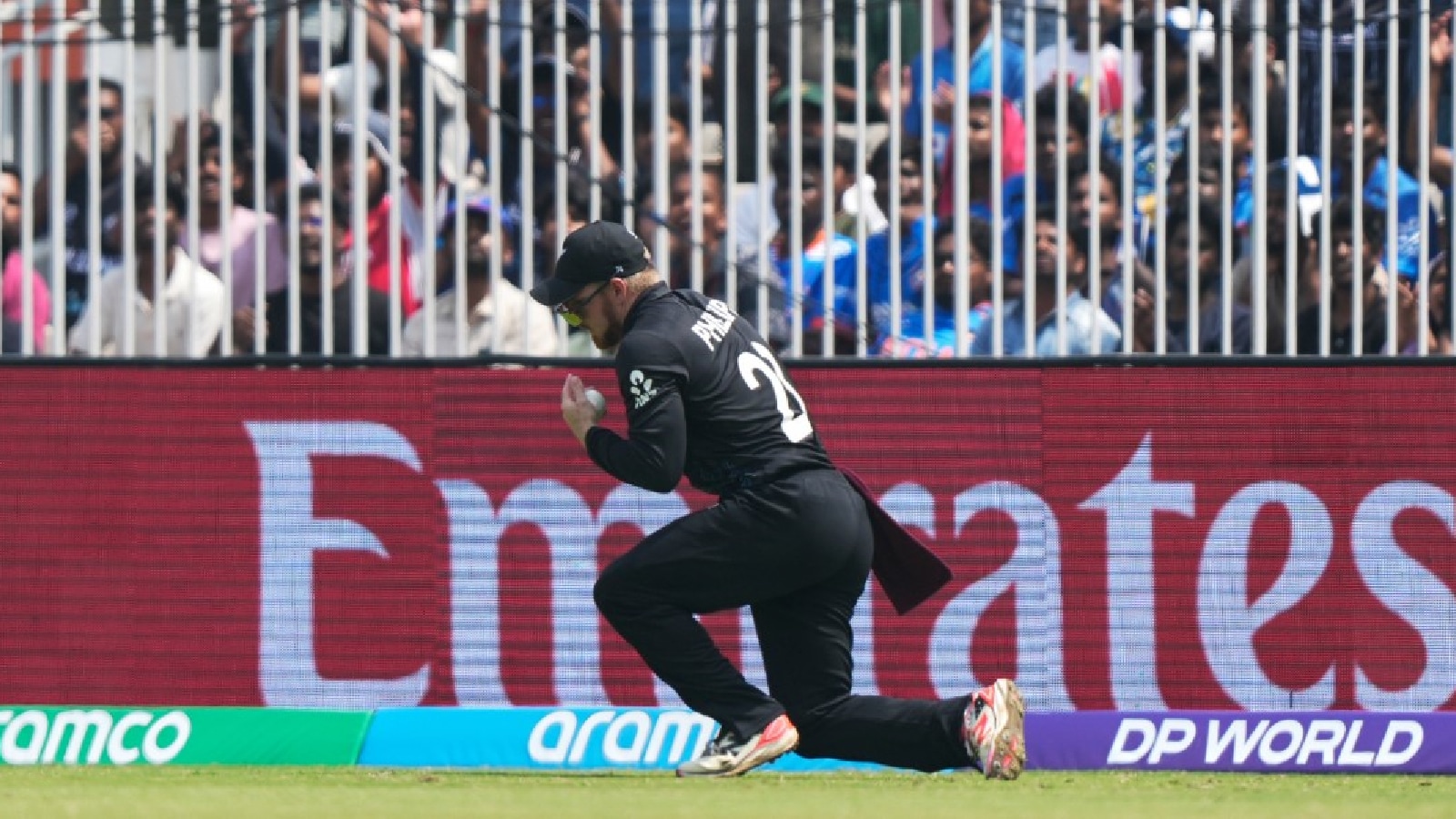 Time, says Phillips, is his biggest enemy when catching. Too much time to catch the ball, too much time for negative thoughts to creep in. (AP)
Stillness is fundamental. Unlike the South African backward point prowlers, he does not walk towards the batsman as the bowler releases the ball. “You try to be as still and as reactionary as possible from that,” he points out.
His pre-game training involves a lot of high catches, not just because they are the easiest to complicate, but they are the most frequent ones, too. “Most of the time, you get a very easy catch. Make sure that you take that one. But there is nothing like an easy catch in the game,” he says.
But he makes sure he studies the ground before every game. “Every ground I go to, I try to understand the dimensions of it, try to get a 360 (degrees) around the ground to catch the different angles the catches would come. If it’s a day game, I like to see the sun from different angles at different times. You see the sky with slightly different colours,” he says.
Story continues below this ad
He dissects the ground with forensic eyes. “Some grounds have better gaps than others. In places like Ahmedabad, where there’s a bit of a ring of fire out there, understanding what the best body positions to get into if the ball goes through those lights and comes back out is important,” he says.
Flying an aircraft is different from being airborne when taking a catch. A licensed pilot, he is in a caged cockpit when steering a steel bird several feet above the sea level. “Obviously, it’s a slightly different kind of flying,” he says.
When flying on the pitch, he could feel the air, the turf, the light. More than self-gratification, he loves to entertain the audience. “People enjoy seeing feats of athleticism. Whether you get there or not, it is part of all the entertainment. And I do enjoy being in the air, and I guess using my body to its full potential,” he says.
Phillips has made the spectacular look routine. But every time he takes a blinder, he takes the breath away, even if he has taken a thousand similar catches.






 English (US) ·