

 1 hour ago
5
1 hour ago
5
ARTICLE AD BOX
AAIB's preliminary report says SWISS flight LX147 aborted take-off in Delhi after its left-hand engine failed, triggering a loud bang and flames. Investigators found debris and extensive internal damage, while analysis of the flight recorders remains under way.
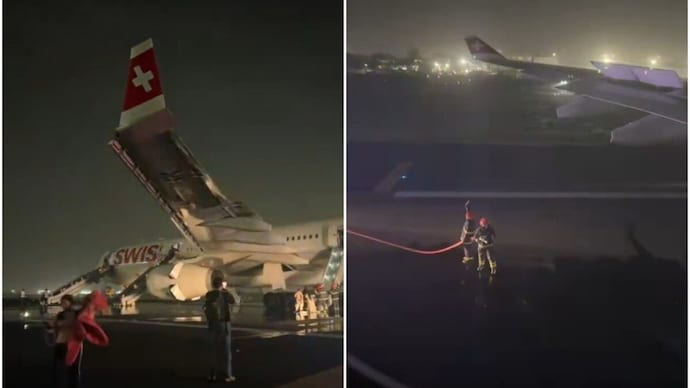
Smoke was seen emerging from the landing gear of the aircraft.
New Delhi,UPDATED: May 31, 2026 11:48 IST
The Aircraft Accident Investigation Bureau (AAIB) has released its preliminary report into the serious incident involving a Swiss International Air Lines flight that suffered an engine failure during take-off at Delhi's Indira Gandhi International Airport on April 26.
According to the report, SWISS flight LX147 from New Delhi to Zurich was involved in a rejected take-off at around 1:27 am after the failure of its left-hand engine. The AAIB has categorised the occurrence as a "serious incident" that left six people injured.
The Airbus A330-343 was carrying 245 people on board, including 232 passengers and 13 crew members. The preliminary report said the flight crew rejected the take-off after the aircraft's left-hand engine failed at a speed of about 106 knots. The pilots immediately informed air traffic control and requested emergency assistance.
The crew later reported hearing a "loud bang" and observing a large flame emanating from Engine No. 1. The aircraft reportedly veered to the left before the pilots successfully brought it to a stop on the runway.
A full emergency was declared at Delhi Airport, with all seven emergency gates opened. Four passengers sustained injuries during the incident.
As part of the investigation, the AAIB carried out a visual inspection of the aircraft and observed small metal particles and debris in the exhaust section of the affected engine.
Both flight recorders -- the Solid State Flight Data Recorder (SSFDR) and the Solid State Cockpit Voice Recorder (SSCVR) --have been removed for further analysis. The bureau said crew data, flight data and air traffic control records are being examined as part of the ongoing probe.
The AAIB said the engine involved in the incident will be retrieved for a detailed examination to determine the root cause of the failure.
France's Bureau of Enquiry and Analysis for Aviation Safety (BEA) has appointed an accredited representative to assist the investigation, while Airbus and the European Union Aviation Safety Agency (EASA) have also been associated with the probe.
The preliminary report noted several findings during the engine examination. External observations before the borescope inspection found broken bolts and spacers of the high-pressure/intermediate-pressure bearing support in the thrust reverser ducts. High-pressure bleed valves were also found partially blocked with debris.
During the core engine borescope inspection, investigators observed damage to the High Pressure Turbine blades and Nozzle Guide Vanes.
Damage was also found in the Intermediate Pressure Turbine blades, Low Pressure Turbine blades, and High Pressure Compressor blades and stator vanes.
The report said the high-pressure shaft and intermediate-pressure shaft were seized, preventing a complete inspection.
However, investigators found no signs of impact damage or blade distortion in the Intermediate Pressure Compressor, although the IPC shaft was also seized and could not be fully inspected.
The AAIB said further analysis of the engine and flight recorder data is underway and safety recommendations may be issued at a later stage of the investigation.
- Ends
Published By:
Sayan Ganguly
Published On:
May 31, 2026 11:48 IST







 English (US) ·