

 1 hour ago
6
1 hour ago
6
ARTICLE AD BOX
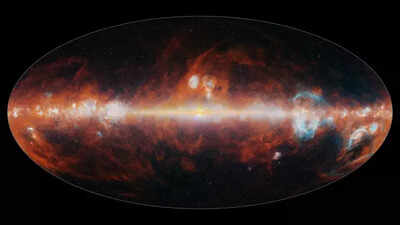
NASA’s SPHEREx telescope produces new 3D map of hundreds of millions of galaxies (Image Source - NASA)
Space observatories tend to work quietly, collecting data long before images reach the public. In March 2025, NASA launched the SPHEREx space telescope with a specific task: to scan the entire sky in infrared light.
By December, the mission had completed its first full sky map, capturing observations in 102 separate infrared wavelengths.
These colours are not visible to the human eye, yet they carry detailed information about galaxies, stars and interstellar material. The dataset marks the first time the whole sky has been mapped in so many infrared bands. Scientists say the information will support research into cosmic inflation, galaxy evolution and the distribution of water and organic molecules in the Milky Way.
NASA’s SPHEREx creates most detailed 102-colour infrared map of the sky to date
SPHEREx travels around Earth roughly fourteen and a half times a day, moving over the poles as the planet rotates beneath it. Each day, it captures about 3,600 images along a circular strip of sky. Over six months, that shifting view builds into a full 360-degree map.Each of the 102 colours represents a specific infrared wavelength. Together they form what is effectively 102 overlapping maps of the same sky. The method used is spectroscopy, which separates light into its component wavelengths.
Different wavelengths reveal different physical processes. Dust clouds glow at some infrared bands and disappear at others. Distant galaxies show subtle colour shifts that indicate how far away they are.
Wide field survey complements other telescopes
Earlier missions, such as Wide-field Infrared Survey Explorer, also mapped the whole sky, though in fewer infrared bands. At the other end of the scale, the James Webb Space Telescope conducts highly detailed spectroscopy but over a much smaller field of view.SPHEREx sits between those approaches. It does not focus narrowly on single targets. Instead, it surveys everything, repeatedly. The telescope uses six detectors, each fitted with a filter containing a gradient of 17 colours. Every image, therefore, records 102 wavelengths at once. A broad census of the sky was built steadily.
A three-dimensional galaxy map will probe cosmic inflation
One of the mission’s central aims is to measure the distances to hundreds of millions of galaxies.
Many of these galaxies have already been mapped in two dimensions by other observatories. SPHEREx adds the third dimension by estimating distance through infrared colour signatures.This three-dimensional map will allow scientists to study how galaxies cluster across vast scales. Those patterns may hold clues to cosmic inflation, a rapid expansion thought to have occurred in the first fraction of a second after the Big Bang.
The expansion shaped the large-scale structure of the universe. Subtle variations in galaxy distribution could offer indirect evidence of how that process unfolded.
Data will support studies of life-building ingredients
Beyond cosmology, the mission will examine the Milky Way for water ice and organic molecules. Infrared wavelengths are well-suited to detecting these compounds in cold molecular clouds where stars and planets form.The full dataset is publicly available, and the telescope will complete three more all-sky scans during its primary two year mission. Sensitivity will improve as maps are combined. For now, the first mosaic stands as a detailed infrared portrait of the sky. It is not dramatic to look at. Mostly numbers, layered maps, faint colour shifts. The implications may take longer to settle.









 English (US) ·