

 1 hour ago
4
1 hour ago
4
ARTICLE AD BOX

There have been reports of erratic weather conditions prevailing in many parts of the country as per predictions by the India Meteorological Department, which expects rainfall, thunderstorms, hailstorms, and strong winds to prevail in many areas.
The latest bulletin, released on April 7 at night, reveals that the cause behind the weather pattern change is due to western disturbances along with cyclonic circulations.This weather phenomenon is considered to be an important factor influencing weather conditions in north India especially in the pre-monsoon period. This western disturbance interacts with several cyclonic circulations in northwest and central India.This interaction is expected to bring rainfall in the range of light to moderate, along with thunderstorms and lightning in Jammu and Kashmir, Himachal Pradesh, and Uttarakhand on April 8. These regions are also expected to experience gusty winds at speeds of up to 60 kilometers per hour. Moreover, isolated heavy rainfall may be witnessed in the Kashmir Valley and Himachal Pradesh.
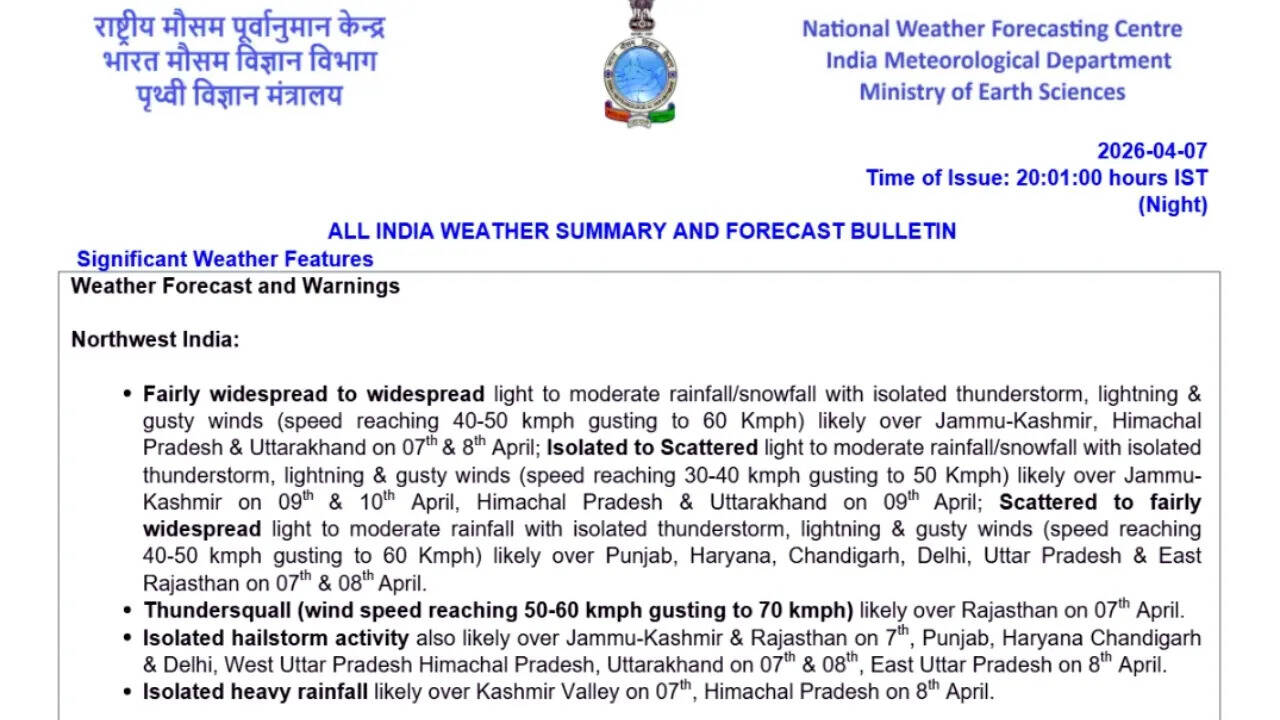
IMD weather bulletin
These areas will also experience scattered to fairly widespread rain showers along with thunderstorms and winds during the mentioned period.
In addition, a warning has also been issued about thundersqualls, especially in Rajasthan, where winds may reach up to 70 kmph.
Warnings related to hailstorms
In addition to the above risks, hailstorms pose one of the major threats due to the prevailing conditions in the region. Isolated hail showers have been predicted in Jammu and Kashmir and Rajasthan, spreading to other areas, such as Punjab, Haryana, Delhi, Himachal Pradesh, Uttarakhand, and Uttar Pradesh on April 8.
Eastern and northeastern India also on alert
The eastern states like West Bengal, Odisha, Bihar, and Jharkhand will also be witnessing thunderstorms, lightning, and gusty winds in the coming days. Thundersqualls with wind speeds of 80 kmph can be witnessed in the Gangetic West Bengal region on April 8.Isolated heavy showers can be seen in Odisha and Gangetic West Bengal regions. Isolated hailstorms can be observed in some parts of West Bengal, Sikkim, Bihar, and Jharkhand.In the northeast region, which includes Arunachal Pradesh, Assam, Meghalaya, Nagaland, Manipur, Mizoram, and Tripura, a fairly widespread rain is expected along with thunderstorms and gusty winds for most part of the week. The state of Arunachal Pradesh may witness isolated heavy showers on several occasions.
Central and western India see scattered activity
In the central parts of India, Madhya Pradesh, and Chhattisgarh will witness showers along with lightning and gusty winds till April 9.
There may also be hailstorms in some localities on April 8.
Western India: Lighter yet significant weather activities
The western region of India, comprising areas such as Gujarat, will witness lighter yet significant weather activity in the coming days in terms of isolated showers, lightning, and gusty winds. However, Gujarat is set to become hot and humid after these weather activities.
South India: Mix of weather
The south part of India, including coastal parts of Andhra Pradesh, Telangana, Rayalaseema, and Karnataka, will see isolated showers and lightning in the coming days.
Unlike northern parts, the south is experiencing higher humidity at the same time.Hot and humid weather conditions have been particularly foretold for Kerala and coastal Karnataka, thus indicating that opposite weather conditions continue to dominate the Indian atmosphere presently.
Temperature observations and trends
The effects of these weather conditions can be seen in temperature trends as well. As per IMD observations, a decrease in maximum temperatures up to 3-5 degree Celsius has been observed in northwest India where temperatures will continue to be below normal for the coming few days.While it is expected that rainfall activity would ease out after April 9, which means that regions such as Delhi and surroundings will observe dry weather in the coming few days, however, there could be a new wave of wetness coming towards the Western Himalayas from April 11.






 English (US) ·