

 5 days ago
10
5 days ago
10
ARTICLE AD BOX
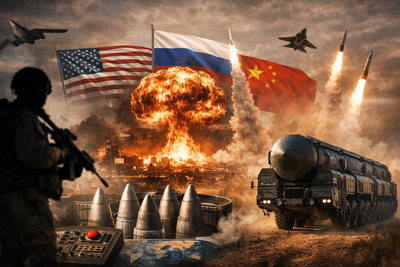
In a badly fractured world with ongoing kinetic conflicts , frequent terrorism driven strikes, unimaginable geopolitical churning and even economics being weaponised, the world is truly at war with itself as never before since the end of World War 2 in 1945.
That these conflicts are impacting both nuclear and near nuclear powers, is understandably a cause of global concern with international institutions like the UN or its Security Council more or less incapable of influencing any nation especially the powerful nuclear states to exercise restraint if matters ever get worse. The possession of nuclear weapons in a nation’s arsenal was not only considered sharpening its offensive capabilities but a credible deterrence.
Unfortunately, wars do get waged and fought, at times, under the nuclear threshold with the threat of a power, under defeat, may take the extreme step putting other nations in nuclear devastation. The threat of a nuclear war was in existence right throughout the 1950s to early 90s synonymous with the Cold War period. The threat was aptly recognised as , if a nuclear war ever broke out, it would be Mutually Assured Destruction ( MAD ) of those fighting each other if not the total end of God’s world.
Better sense had prevailed with the two nuclear super-powers , US and Russia, who had signed in 2010 the Strategic Arms Reduction Treaty ( START) which expired last week.
For all its shortcomings, the Treaty had curbed, to some extent, a nuclear arms race as it restricts the number of warheads which these nations could deploy. As both US and Russia have got down to negotiate a new Treaty in Abu Dhabi over the last week, the nation whose nuclear arsenal is rapidly growing, China has rejected calls from these two nations to join in the talks with the US and Russia.
The Chinese govt though expressing regret over the expiry of the START has formally conveyed that they “ will not participate in nuclear disarmament negotiations at this stage.” China further stated that their “ nuclear capabilities are of a totally different scale as those of the United States and Russia.” The Chinese nuclear arsenal is reportedly growing by 100 nuclear warheads per year and they have around 600 warheads with them.
According to the Stockholm Peace and Research Institute ( SIPRI ), a global authority on military matters, Pakistan has nearly 170 nuclear warheads to India’s 180 while Russia and America control more than 80 percent of the total nuclear warheads in the world. The START , however, limits both the nuclear super powers to a maximum of 1550 warheads. India faces two adverserial nuclear nations in its neighbourhood. Though India has steadily built up its nuclear capabilities over the past decades, yet it has to ensure its nuclear readiness at all times.
However, India has been working towards nuclear disarmament all across the world since the early 1950s. Not many are aware that it was as early as 1945, that Pt Jawaharlal Nehru had met then a young bright scientist Homi Bhabha and asked him to commence working on Atomic Energy for India, soon to get its independence would require proficiency in Atomic Energy for peaceful needs——- the rest is history with otherwise a pacifist, India’s first PM Nehru known for his “scientific temper” encouraged and established India’s Atomic Energy Department.
It was also in 1954 that India was the first country to call for a global ban on nuclear testing . In 1974, PM Indira Gandhi spearheaded India’s first nuclear test which, off course, invited many sanctions from the West, especially the US. However, it was then India’s young PM Rajiv Gandhi who in 1988 initiated a three stage Action Plan to the UN for total nuclear disarmament. Rajiv Gandhi’s initiative was widely acclaimed across the world.
In 1998, during then Indian PM Vajpayee ‘s govt, India also carried out comprehensive nuclear testing. Despite not signing the Nuclear Proliferation Treaty ( NPT), India has adhered to strict export controls and other nuclear safeguards for itself and other nations. By declaring its No-First-Use ( NFU) policy with clarity, India maintains a doctrine of credible minimum deterrence not to employ nuclear weapons first and definitely not against nuclear weapon states.
However, India retains the right to use nuclear power against any biological and chemical attack on it.Overall, India signed and ratified the Partial Test Ban Treaty which bans atmospheric, outer space and under water testing of nuclear weapons.
As regards the Comprehensive Nuclear Test Ban Treaty, India will only support the treaty if nuclear weapon states commit to a time-bound nuclear disarmament. India has observed a nuclear testing moratarium on nuclear testing since May 1998. Meanwhile with the START having expired, the UN Secretary General , Antonio Guterres has warned the world that “ for the first time in more than half a century, we face a world without any binding limits on the strategic arsenals” of Russia and the US. He also expressed that “ this dissolution of decades of achievement could not come at a worse time—— the risk of a nuclear weapon being used is the highest in decades.” With China not joining the START and Pakistan, eternally irresponsible, India has to factor in its security calculus these nuclear uncertainties and thus revisit its nuclear doctrine and preparedness despite the fact that the world recognises India as a responsible power. Simultaneously, India must continue to work for global nuclear disarmament which is the only path to avoid a Nuclear Armageddon.







 English (US) ·