

 2 hours ago
6
2 hours ago
6
ARTICLE AD BOX

In the age of AI, layoffs have acquired a numbing regularity all over the world. They are still shocking though due to sheer numbers. These days, layoffs arrive in waves: 13,000 here, 12,000 there, 10,000 somewhere else.
Each announcement is somehow flattening individual stories into statistics. Yet beneath the scale lies something more intimate, a quiet unravelling of identity, routine, and certainty. The world has never changed so fast.Work has long been more than a paycheck; it is structure, validation, even shorthand for self-worth for people. Which is why losing it can feel less like a professional setback and more like a personal erasure.
But if layoffs are becoming a structural feature of modern work, then resilience: emotional, psychological, and social, must become one too. Here are three ways that studies show we can navigate the world when the pink slip shows up.

Get out of the 24X7 working and connected mode. Resist the urge to immediately ‘fix’ everything immediately.
First, take a pause
Get out of the 24X7 working and connected mode. Resist the urge to immediately ‘fix’ everything immediately. The first instinct after a layoff is one of urgency – update the CV, scan job portals, reach out to contacts, do something.
But research suggests that this reflex almost always backfires. Studies in occupational psychology have consistently shown that job loss triggers responses similar to grief—denial, anger, anxiety—because it disrupts identity as much as income.
A widely cited meta-analysis by Paul and Moser, known for their influential 2009 meta-analysis, ‘Unemployment impairs mental health: Meta-analyses’ found that unemployment is strongly linked to psychological distress, including depression and low self-esteem.The key insight? Recovery is not just about re-employment; it begins with emotional processing. Taking a pause is not indulgence; it is strategy. When you allow yourself to sit with the shock, you avoid making decisions from a place of panic. Cognitive overload is real: trying to solve everything at once often leads to paralysis rather than progress. Breaking the moment into manageable emotional steps, like, “today I can rest, tomorrow I can plan”, restores a sense of control.
Just as importantly, pausing helps separate the event from your identity.
A layoff is something that happened to you; it is NOT who you are. That distinction is not subtle. It is foundational to recovery.
Catch up with life
Reclaim your time, relationships, and neglected joys. Work, especially in high-pressure industries, tends to crowd out everything else. Friendships become occasional check-ins, hobbies turn aspirational or are forgotten, and the rest of life’s pleasure sort of feels earned-like you have to work for it, or it won’t come.
Make those lost joys a necessity in your time off. As abrupt as a layoff is, the most underrealized under appreciated surplus from it is time.
Using that time intentionally can be deeply stabilizing. Behavioral science shows that social connection acts as a buffer against stress. According to research from the American Psychological Association, strong social ties significantly reduce the impact of major life disruptions.
Conversations with friends don’t just distract – they recalibrate perspective. They remind you that your identity exists outside performance reviews and quarterly targets.This is also the moment to return to things that were perpetually postponed… that film you never watched, a book you abandoned halfway, a hobby that once mattered. These are not trivial pursuits. They rebuild continuity with a version of yourself that existed before work consumed your time.
In a culture that equates productivity with worth, choosing to simply be is an act of resistance that will definitely boost your spirits.
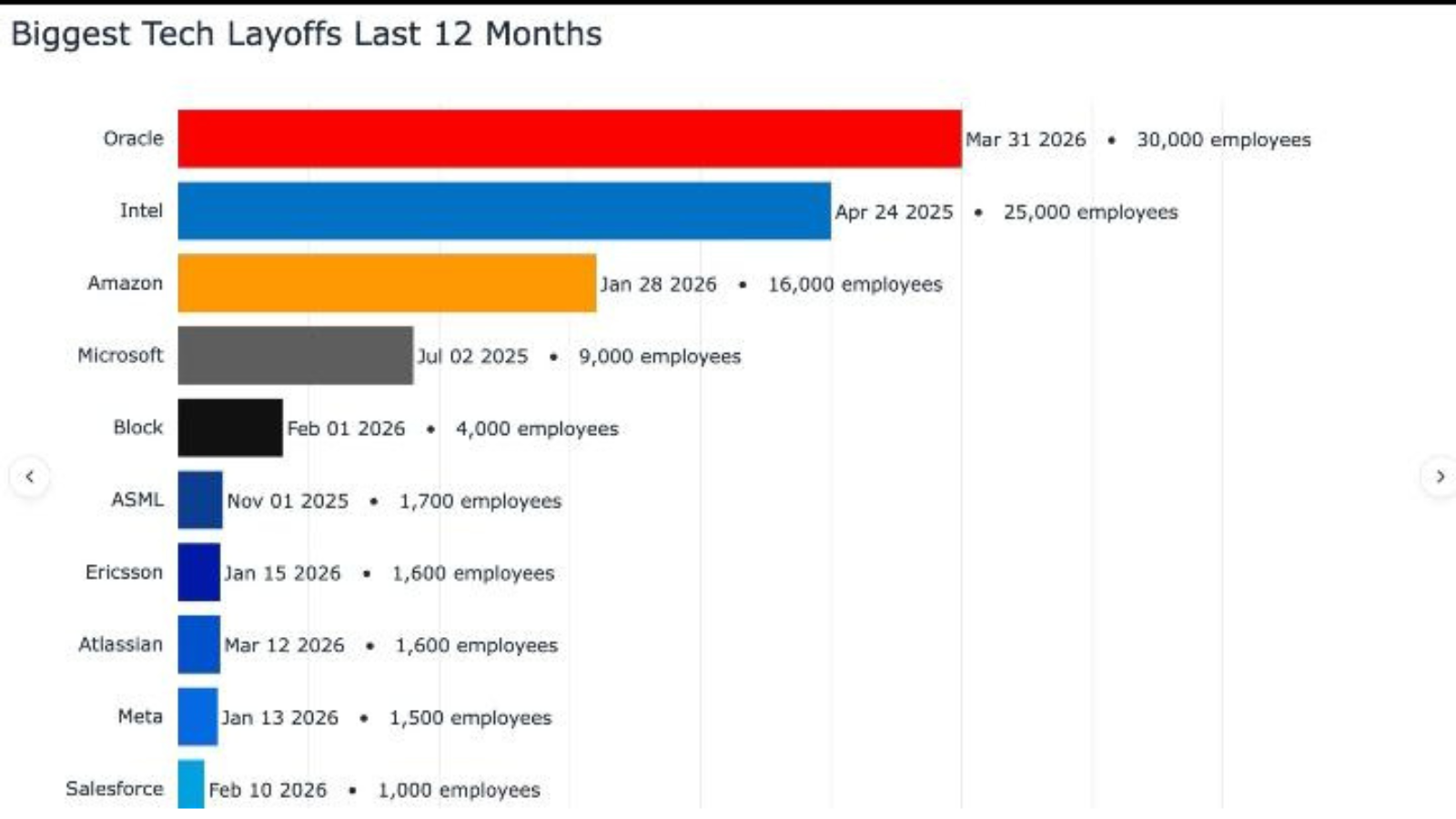
oracle layoffs 30,000 employees
Move your body
The most underestimated mental health intervention is “go for a walk”. It’s an advice so common that it risks being dismissed. Yet its effectiveness is unusually well-documented. Physical activity directly influences mood by regulating stress hormones like cortisol and increasing endorphins and serotonin.
A study published in ‘The Lancet Psychiatry’ in 2018, analyzing over a million people, found that individuals who exercised regularly reported significantly fewer poor mental health days per month compared to those who did not.
Even simple activities—walking, light cardio, stretching—had measurable benefits. For someone navigating anxiety, this matters. The body often processes stress before the mind can articulate it, mostly through restlessness, fatigue, or disrupted sleep.
Regular movement provides a release valve. It also introduces routine at a time when structure has disappeared, anchoring the day in something predictable and within your control.

A study published in ‘The Lancet Psychiatry’ in 2018, analyzing over a million people, found that individuals who exercised regularly reported significantly fewer poor mental health days per month compared to those who did not.
Meditation and mindfulness can complement this. Research from Harvard Medical School has shown that mindfulness practices can reduce rumination: the repetitive negative thinking that often accompanies job loss. Together, movement and mindfulness don’t just “lift mood” in a vague sense; they actively interrupt the stress cycle.
This brings us back to the most important lesson we started with. You are not your job.Perhaps the most difficult—and necessary—shift is philosophical. For decades, professional identity has been tightly interwoven with personal worth. The question “What do you do?” is often shorthand for “Who are you?” But layoffs, especially at a scale never seen before, expose the fragility of that equation. When entire teams or divisions are let go, it becomes clear that job loss is rarely a referendum on individual value.
Economists and workplace researchers increasingly point out that layoffs are structural decisions, driven by market shifts, automation, or cost-cutting, rather than personal failures. Detaching self-worth from employment is liberating. It allows you to approach the next step from a place of agency rather than inadequacy.







 English (US) ·