

 1 week ago
12
1 week ago
12
ARTICLE AD BOX
Last Updated:January 29, 2026, 21:35 IST
According to the data, compared to last year's survey, India has added 735 km of high-speed corridors – roughly 2 km per day on average

The Economic Survey said along with the railways, road transport and highways account for over half of the Centre's total capital expenditure through FY25. (Image: PTI)
The total operational length of high-speed corridors in India crossed 5,000 km this financial year, touching 5,364 km by December 2025.
The Economic Survey 2025-2026 described roads and highways as the “primary driver of India’s infrastructure". According to data, compared to last year’s survey, India has added 735 km of high-speed corridors (HSC) – roughly 2 km per day on average. As of December 2024, India had 4,629 km.
WHAT DOES THE DATA ANALYSIS SHOW?
The analysis of the data in the survey shows that the main progress was achieved in the national high-speed corridors that increased by 578 km in a year – from 2,474 km as on December 31, 2024 to 3,052 km as on December 31, 2025, translating to about 1.6 km added per day on average. On June 30, 2025, the length of the operational national HSCs was 2,636 km.
In the case of the state high-speed corridors, the growth has been from 2,155 km at the end of 2024 to 2,312 km by the end of 2025. So, the analysis shows that India had close to 460 km of state high-speed corridors in 2014.
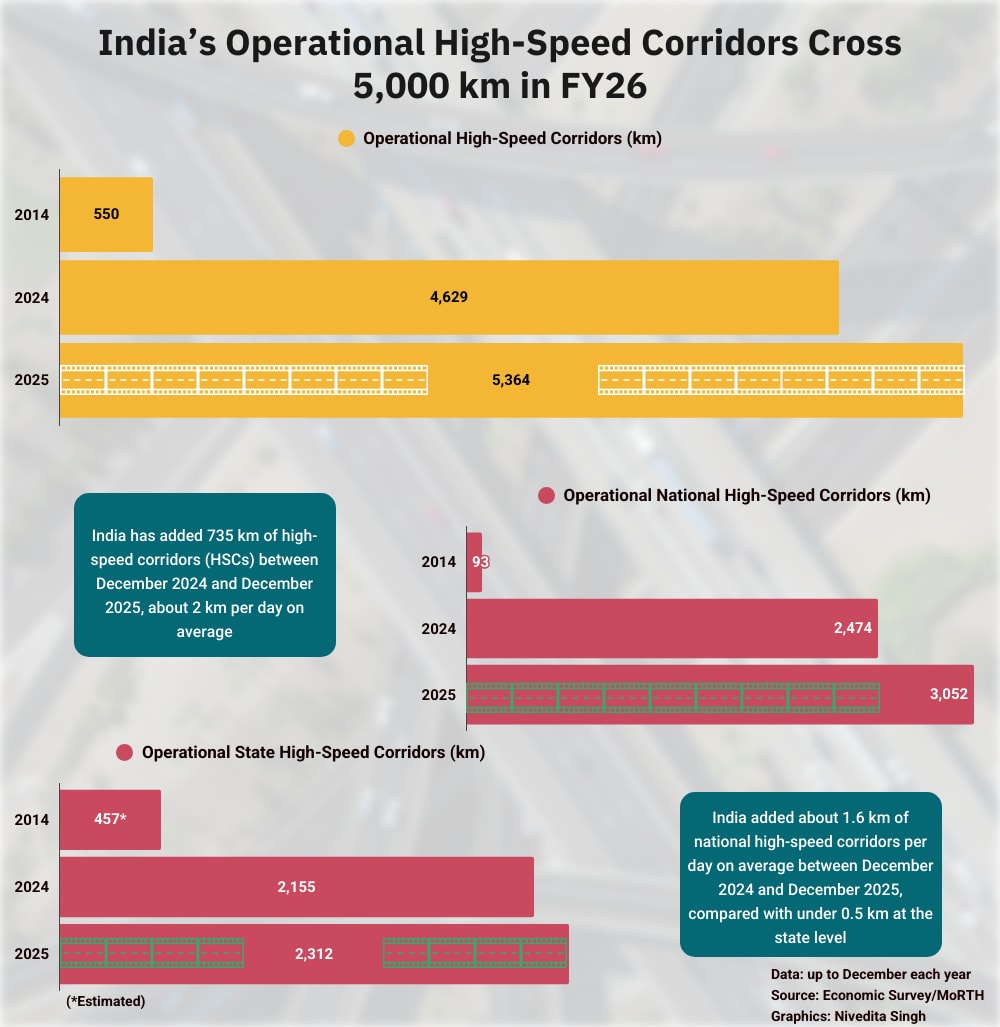
The survey shows that in 2014, India had only 550 km of HSCs, showing an increase of more than 10 times in over a decade. While national high-speed corridors stood at just 93 km in 2014, state high-speed corridors are estimated to have been around 460 km at the time.
“To align freight speeds with global benchmarks, the HSC network expanded from 550 km in 2014 to 5,364 km by December 2025. A total network of approximately 26,000 km is targeted by FY33, with 9,366 km currently under implementation," reads the Economic Survey 2025-2026.
RING ROADS, BYPASSES PLANNED FOR CITIES
The survey highlighted that a new policy for access-controlled ring roads and bypasses has been finalised for cities with populations over one lakh.
“This employs innovative cost-sharing models, such as land pooling and value capture, to transform urban centres into growth engines," it stated.
It said roads and highways were the “primary driver of India’s infrastructure", transitioning from rapid capacity expansion to a focus on logistic efficiency and technological integration.
“Over the past decade, sustained investment and policy reforms have significantly expanded the national highway (NH) network and improved construction pace, laying a stronger foundation for multimodal connectivity and economic integration," it added.
The report noted that priority is accorded to highway projects linking economic node connectivity, including ports, inland water transport (IWT) terminals, and industrial corridors to lower logistics costs. Along with the railways, road transport and highways account for over half of the Centre’s total capital expenditure through FY25, it said.
Handpicked stories, in your inbox
A newsletter with the best of our journalism
First Published:
January 29, 2026, 21:35 IST
News india 'Primary Driver Of India's Infra': Economic Survey Shows High-Speed Corridors Crossed 5,000 Km In FY26
Disclaimer: Comments reflect users’ views, not News18’s. Please keep discussions respectful and constructive. Abusive, defamatory, or illegal comments will be removed. News18 may disable any comment at its discretion. By posting, you agree to our Terms of Use and Privacy Policy.
Read More








 English (US) ·