

 22 minutes ago
3
22 minutes ago
3
ARTICLE AD BOX

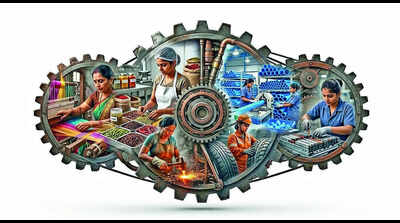
More and more women are taking up roles that were traditionally done by men in Gujarat's key industries
By 8am, the heat inside Surat’s textile processing units is already rising as women in scarves and gloves move between towering dyeing machines, checking fabric loads in temperatures that can cross 50 degrees celsius in summer.
Hundreds of kilometres away in Sanand, young women handle precision-led semiconductor and food manufacturing processes inside controlled factory environments. In Dahej, women who had never stepped into a tyre shop are now working rotating shifts on industrial shop floors, manufacturing tyres through the night. At JSW MG Motor India, women made up barely 4-5% of the workforce when production-floor hiring began in 2018.
Today, they account for around 41% of employees. What seemed unlikely a few years ago is now reshaping Gujarat’s manufacturing landscape, driven by labour shortages, policy support, changing factory economics and gradual workplace reforms.From Fringes to the Mainstream of ManufacturingFor years, women inside Surat’s textile processing units were largely confined to peripheral roles such as cleaning shop floors, serving tea or assisting with support work.
The production floor itself remained overwhelmingly male-dominated, particularly around heavy machinery such as jet dyeing and stenter units, where temperatures soar during the summer months. That boundary is now beginning to blur.Across textile units in Surat, women are increasingly operating machines, handling production processes and taking up responsibilities once considered unsuitable for them.
Industrialists say the transition was initially driven by labour shortages, with factories struggling to retain male workers for physically demanding shifts.“Due to labour shortages, we started employing women in specific operational roles where they could work comfortably. To some extent, this has helped address the workforce gap,” said Pramod Chaudhary, chairman of Pratibha Group, where women now account for around 10% of the workforce in textile processing operations.Factory owners say women have adapted quickly to technical roles that require precision and consistency rather than brute physical strength.For workers like Sahiba Parveen, 22, who migrated from Bihar, factory employment represents far more than supplemental income. “My husband supported me when I started working. Since both of us work, we can save for our future,” she said. Aarti Sharma, 40, said, “I earn around Rs 23,000 a month, which is close to what my husband earns.”The New Shop Floor DisciplineIndustry leaders say the growing presence of women is reshaping workplace culture across sectors. “When women entered our factory floors, we observed changes beyond just workforce numbers,” said Saji Varghese, senior general manager and factory head at the MRF Dahej plant. “There was greater attention to process, tidier workspaces, improved housekeeping and better retention.”MRF Tyres is also looking to increase the number of women workers at its Dahej plant from around 300 to 420.Yeshwinder Patial, CHRO, JSW MG Motor India, said, “In automotive manufacturing, especially in paint shops where precision shade matching is critical, women workers immediately flag inconsistencies. Consistency and discipline are qualities we have observed. At Halol, the company’s battery assembly facility operates with nearly 80% women workforce across three shifts.“The presence of women in the workforce has increased over the last few years. One of the key reasons is that they are dedicated and focused at work,” said Prem Raj, founder and MD of Vadodara-based Conmat Heavy Industries.Ananda Bhatt, an HR professional with a multinational, said women are now being recruited across departments where their presence was once rare. “Financial independence is a key factor for working women,” she said.The shift is especially visible in semiconductor and electronics manufacturing. According to industry estimates, units across the Sanand industrial belt currently employ nearly 8,000 workers in production operations, with a steadily rising share of women entering factory-floor roles.The trend is visible in Gujarat’s pharmaceutical sector as well, where companies are reporting a steady rise in women workers beyond traditional packaging roles.“In pharmaceutical companies, packaging has historically had a high share of women workers, but we are now seeing more women being trained as machine operators as well,” said Sanchit Chaturvedi, chairman of the Indian Drug Manufacturers’ Association (IDMA) - Gujarat. “Many women who could not complete formal science degrees are still able to receive technical training and work in manufacturing operations.”According to industry estimates, women account for around 30% of the workforce across pharma factories in Gujarat.
Industry representatives said companies have also strengthened safety and workplace support systems for women employees.“Women are increasingly being deployed in precision-oriented manufacturing roles, particularly in semiconductor and electronics units,” said Ajit Shah, president of the Sanand Industries Association.The Policy Shift That Changed Factory FloorsIndustrialists say policy changes permitting women to work night shifts under regulated safety norms marked a major turning point for manufacturing sectors operating continuous three-shift cycles.“When the govt facilitated recruitment of women in night shifts with specific conditions, it opened many opportunities for factory owners,” said Varghese of MRF Tyres. “Otherwise, industries like ours found it difficult to meet production targets.”The shift has also pushed companies to strengthen workplace infrastructure and safety systems. Across industrial clusters, factories have introduced dedicated transport services, monitored pick-up and drop facilities, surveillance systems, women supervisors and crèche support for employees with children.At Sanand, Nestlé India has employed a significant number of women workers since starting operations at its plant in 2021. Industry sources said women account for around 25% of the workforce at the facility, which provides daycare support, dedicated transport services and additional safety measures, particularly for employees working night shifts.The rise in women workers is also becoming visible across Gujarat’s spinning sector, which saw major investments after the state’s 2012 textile policy.“In the spinning sector, we have seen an increase in women workers across different stages of manufacturing,” said Ripple Patel, vice-president of the Spinners’ Association Gujarat. “In many mills, women are now working not just in cleaning operations but also as machine operators.”According to the association, Gujarat has around 120 spinning mills employing nearly 25,000 workers, of whom roughly a quarter are women.With inputs from Tushar Prabhune






 English (US) ·