

 1 hour ago
4
1 hour ago
4
ARTICLE AD BOX
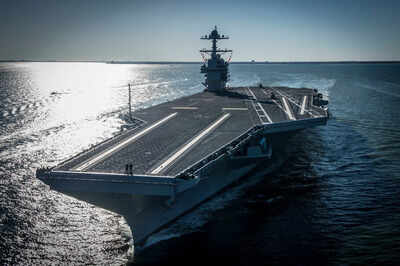
FILE - In this photo provided by the U.S. Navy, the USS Gerald R. Ford embarked on the first of its sea trials to test various state-of-the-art systems on its own power for the first time, April 8, 2017, from Newport News, Va. (Mass Communication Specialist 2nd Class Ridge Leoni/U.S. Navy via AP, File)
In recent weeks, the US military has built up forces close to Iran, in what President Trump has referred to as an "armada." The armada includes the aircraft carrier Abraham Lincoln, which is accompanied by three warships that are equipped with Tomahawk missiles and that were used to strike two of Iran's nuclear facilities last June.
The warships also carry air defences. The carrier's stealthy F-35 fighters and F/A-18 attack planes are well within striking distance of dozens of targets in Iran.The US recently ordered a second aircraft carrier strike group to the region. This includes the navy's most advanced aircraft carrier, the USS Gerald R Ford, and three of its accompanying destroyers. On Wednesday, they were on course to Strait of Gibraltar, according to flight and ship-tracking data reviewed by NYT.Additionally, another destroyer was sent to the Northern Arabian Sea, and one is en route, according to an official, bringing the total in the wider region to 13 destroyers. The Muwaffaq Salti Air Base in Jordan appears to have become a central node for the US assets of the buildup. At least two waves of attack aircraft arrived between mid-Jan and mid-Feb, bringing the number to nearly 30.In addition to the attack aircraft, four electronic warfare jets, which are used to jam radar and communications systems, arrived in Jordan at the end of Jan. And a Jan 30 satellite image showed at least five MQ-9 Reaper drones at the base.And the Pentagon has dispatched more Patriot and THAAD air defenses to help protect troops there from Iranian missiles. There are 30,000 to 40,000 US troops in the region. NYT








 English (US) ·