

 51 minutes ago
5
51 minutes ago
5
ARTICLE AD BOX

AI generated image for representation
Conversations around screen time aren’t something new. Many parents are aware of the ill-effects of excess screen exposure on children. But now, one parent’s experience after unexpectedly going “completely screen-free” has sparked a conversation many families can relate to.
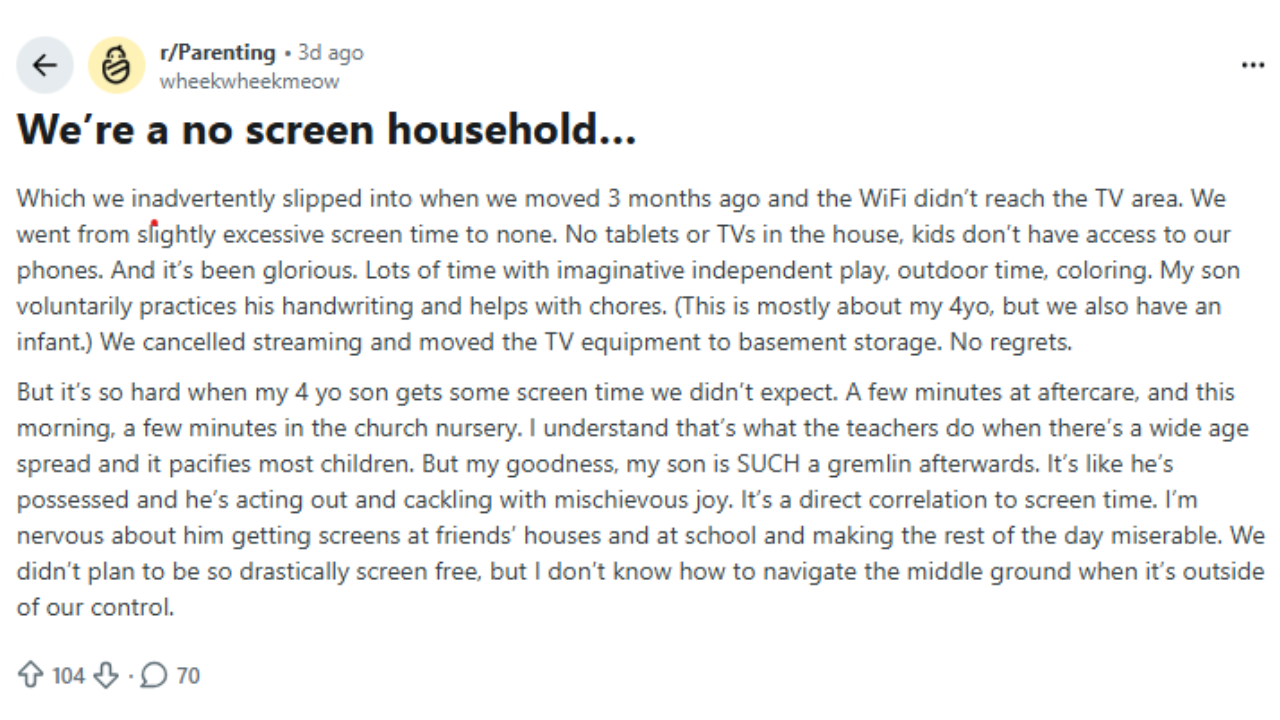
“Even brief screen exposure makes my son act like a gremlin”
Sharing the experience on a Reddit post, a parent wrote, “We’re a no screen household,” and explained that their family unexpectedly became one due to Wi-Fi issues. “ The parent further explained that since there was no exposure to screens, their kids naturally became drawn to screen-free healthy activities such as coloring or outdoor activities, and sometimes they even help with the household chores.
But while life at home felt calmer to the family, a new challenge emerged when their kids got unexpected screen exposure outside the home.
The parent shared that even a few minutes of unexpected screen time affected their 4-year-old son’s behavior afterwards. . Describing the change, she wrote, “My son is SUCH a gremlin afterwards,” adding that he becomes overly mischievous and difficult to manage.The parent feels there’s a direct correlation between screen exposure and the hyperactive behaviour that followed. Now, they feel worried about the situations they cannot fully control.
“We didn’t plan to be so drastically screen-free,” they admitted, “but I don’t know how to navigate the middle ground when it’s outside of our control.”
Courtesy: Reddit
Experts say making screens ‘forbidden’ can increase obsession
“This is a fascinating case, but from a psychological standpoint, the child’s ‘weird’ reaction is completely expected,” says psychologist and parenting coach Dr. Khushboo Modh. According to her, “The child’s brain has been completely starved of digital stimulation, and when they are suddenly exposed to a screen, even briefly, their brain experiences a massive dopamine shock.
It is sensory overload. They act ‘weird,’ (which usually looks like zoning out, hyper-arousal, or intense irritability when the screen is removed) because their nervous system simply does not know how to process and regulate that sudden spike in dopamine.
” Dr. Khusboo further adds that putting a complete ban on screens also triggers the Forbidden Fruit Syndrome. “By completely banning screens, we inadvertently turn them into the ultimate prize.
The child’s reaction is driven by a subconscious scarcity mindset: ‘I don’t know when I’ll see this again, so I must hyper-fixate on it now,’” she adds. Parenting author Sathya Ramaganapathy shares similar thoughts. She believes, “Going completely screen-free is just not realistic.” According to her, being too strict about screens can also backfire. “The minute you say no to it, the moment you make something forbidden, it becomes way more appealing.”
“Total restriction is not the same as regulation”

Dr. Khushboo says she always warns parents about the trap of extreme parenting. In her view, total restriction is not the same as regulation. “When parents enforce a 100% ‘no-screen’ policy in a highly digitized world, they are essentially raising their child in a sterile digital bubble,” she adds.According to Ramaganapathy, the better move would be “allow it, but make it more intentional.” Whether it's TV, internet, or gaming, she suggests making it a conscious choice, and not just something that your kids drift into mindlessly.
What experts practice and recommend about healthy screen exposure
AI generated image for representation
Dr. Khushboo also highlights that the goal of modern parenting should not be to raise a child who is terrified or obsessed with screens. The goal is rather to raise a child who knows how to coexist with technology safely. She suggests, “We do this through moderation, co-viewing, and teaching self-regulation, rather than extreme isolation. We can’t prepare our children for the future by hiding them in a digital bubble today.Calling the internet a “rabbit hole,” Ramaganapathy recognises how kids can stumble upon completely inappropriate content. “So, if possible, watch things together when you can. Definitely set some ground rules around what they can watch, how long they can watch, and where they can use the devices, you know, public space, and so on. Ask them what they have been watching, you know, what they think about it,” she advises.
Being a mom of two herself, the parenting author says she understands how difficult it is to raise children in this day and age, especially when they hit teen years, and that’s why she says building these habits early on can make a big difference. Since children will eventually have to encounter screens in the technology driven world, avoiding them is both unrealistic as well impractical. Experts believe modern parenting does not need families to go completely “screen free,” but instead it needs parents to focus on creating healthy and intentional screen habits for their kids.









 English (US) ·