

 6 days ago
7
6 days ago
7
ARTICLE AD BOX
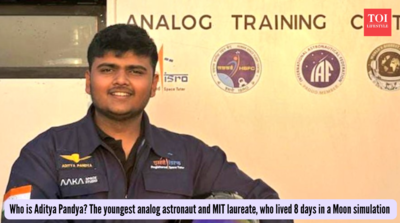
At 17, Aditya Pandya became India's youngest male analog astronaut, participating in an eight-day lunar simulation in Gujarat. He not only lived in the habitat but also designed and tested critical systems like air-quality sensors and biometric trackers. This mission aimed to advance India's analog research for future human space endeavors.
India’s space journey has been picking up serious momentum lately. Missions like Chandrayaan-3 didn’t just make headlines, they lit up imaginations. Suddenly, space doesn’t feel like a far-off dream anymore.
Even little kids are talking about becoming astronauts one day.And now, one teenager has taken that dream a step closer to reality.At just 17, Aditya Pandya has made news as India’s youngest male analog astronaut after taking part in a Moon-like simulation mission.
Meet Aditya Pandya, a teen space pioneer
Aditya Pandya, a 17-year-old with a sharp engineering mind, completed an eight-day lunar simulation in the white plains of Dholavira, in Gujarat’s Kutch region.
The mission ran from February 1 to 8 and was organised by AAKA Space Studio, a registered ISRO Space Tutor that works on planetary analog research.Along with three other crew members, Aditya lived inside a container-style habitat built to mirror Moon-like conditions. For eight days straight, the team was completely cut off from the outside world, following strict protocols similar to what astronauts would experience on another planet.
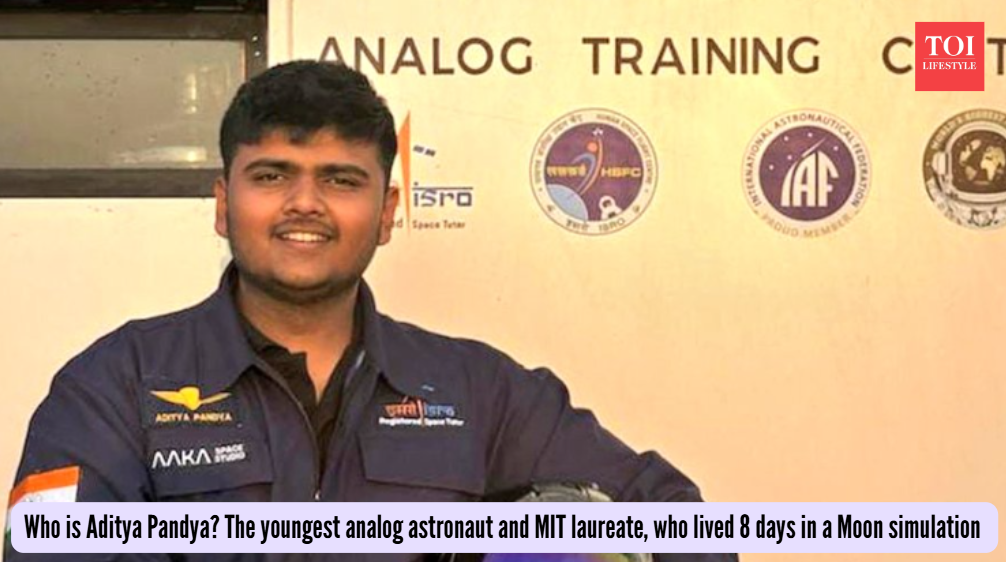
Who is Aditya Pandya? The youngest analog astronaut and MIT laureate, who lived 8 days in a Moon simulation designed by himself (Photo: ANI)
What makes him stand out?
Aditya wasn’t just part of the crew - he helped build the systems he was living with. While staying inside the habitat, he also led the hardware, IoT, and smart-habitat work.In the six months leading up to the mission, he designed and tested air-quality sensors, biometric systems to track crew health, and fault-detection hardware. He even used 3D printing to quickly prototype parts. The habitat was connected to a digital twin system that synced live data with mission control, tracking oxygen levels, health stats, and other critical readings.So while most people his age are worrying about exams, Aditya was stress-testing tech meant for life beyond Earth.
Aditya’s education background
According to his LinkedIn profile, Aditya completed his intermediate education at Asia English School with Science, Maths, and AI. He later earned a certification in Generative AI for data-driven business decision-making between February and April 2025.During the same period, he also completed a related course from the Massachusetts Institute of Technology.
He is currently studying Computer Engineering at the Institute of Advanced Research, Gandhinagar.
What life was like inside the Moon mock-up
Life inside the habitat was anything but easy. The crew followed strict space-style rules - no outside contact, limited supplies, and complete dependence on onboard systems for food and air.They spent the eight days studying how isolation affects the mind, how humans work with machines in tight spaces, and how people make decisions when cut off from the real world.According to ANI, Aditya’s systems performed well under pressure, holding up when it mattered most. The habitat itself recreated Moon-like living conditions - cramped spaces, recycled resources, and constant monitoring, all designed to prepare for future lunar missions.What made Aditya’s role unique was that he got to live inside the very systems he helped create. It’s a rare mix - part engineer, part astronaut.AAKA Space Studio says the mission was meant to strengthen India’s analog research ecosystem by blending hands-on engineering, simulation science, and real-world astronaut-style training, all with future human space missions in mind.







 English (US) ·