

 2 days ago
9
2 days ago
9
ARTICLE AD BOX
Researchers say improving durability is particularly important because window coatings must withstand years of sunlight, dust, rain, and changing weather without losing performance | ChatGPT
Cooling homes without relying on air conditioners has long been a goal for scientists, but most passive cooling materials have one major drawback: they are opaque, making them unsuitable for windows.
Now, researchers are developing transparent glass technologies that could help buildings stay cooler by reflecting unwanted solar heat while allowing excess indoor warmth to escape, potentially reducing indoor temperatures without consuming electricity.A new study published in the journal Advanced Functional Materials describes a passive radiative cooling coating designed to remain effective even after prolonged exposure to sunlight, dirt, and outdoor weather. According to the researchers, the material combines high solar reflectance with strong infrared emission, allowing it to reject incoming heat during the day while releasing stored heat more effectively.
Unlike many previous passive cooling materials that continue cooling after sunset and can make surfaces too cold, the new coating incorporates a phase-change material that stores heat during the day and gradually releases it at night, helping maintain more stable temperatures.
In outdoor tests, the coating achieved an average daytime cooling effect of 4.8°C below ambient temperature, while remaining only 0.6°C cooler than the surrounding air at night, avoiding the problem of overcooling.
The team also reported excellent durability, with solar reflectivity dropping by only 0.6% after 336 hours of ultraviolet exposure and by just 1% after a month of outdoor ageing.
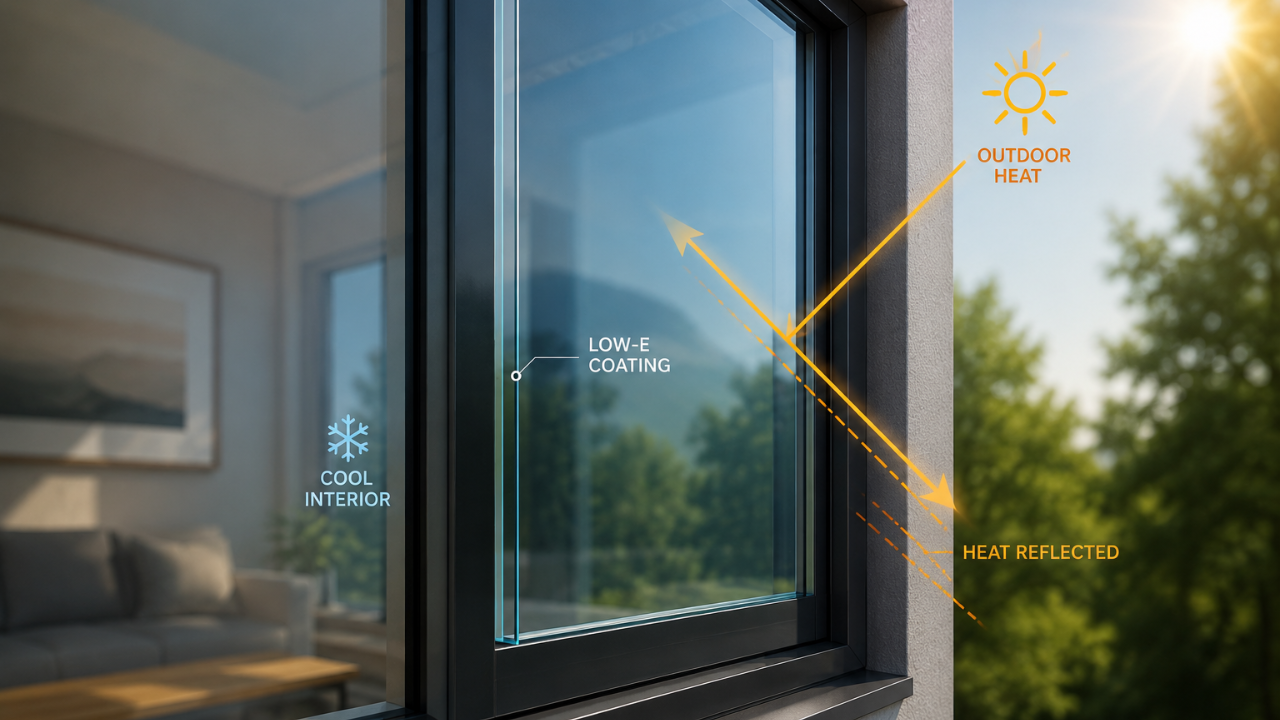
The material combines high solar reflectance with strong infrared emission, allowing it to reject incoming heat during the day while releasing stored heat more effectively (Conceptual) | ChatGPT
How transparent cooling windows workPassive radiative cooling relies on a simple physical principle. Instead of using electricity to remove heat, specially engineered materials reflect much of the Sun’s incoming energy while simultaneously emitting thermal radiation through what’s known as the atmospheric window, a range of infrared wavelengths that can pass through Earth’s atmosphere and dissipate into outer space.
Scientists have been exploring this concept for years, but creating a material that remains transparent enough for windows while still providing meaningful cooling has proven difficult.
Most high-performance radiative cooling coatings appear white or opaque because they scatter visible light along with solar heat.Recent advances suggest that the challenge may be changing. According to research published in Nano Letters, scientists developed a transparent directional thermal emitter that allows visible light to pass through while reducing the temperature of window glass by up to 4.8°C compared with conventional glass under real-world summer conditions.
The researchers say such designs could reduce cooling demand in buildings located in hot climates by allowing heat to escape without sacrificing natural daylight.
Researchers say improving durability is particularly important because window coatings must withstand years of sunlight, dust, rain, and changing weather without losing performance | ChatGPT
Could these windows become part of future buildings?
While the latest technologies remain in the research stage, they address several obstacles that have slowed the adoption of passive cooling materials, including weather resistance, ultraviolet degradation, nighttime temperature control, and maintaining transparency.Researchers say improving durability is particularly important because window coatings must withstand years of sunlight, dust, rain, and changing weather without losing performance. If future studies continue to demonstrate long-term stability, transparent radiative cooling windows could become a practical way to reduce dependence on air conditioning, particularly in regions experiencing rising temperatures and increasing electricity demand.Although more testing will be needed before the technology reaches commercial buildings, these advances suggest future windows may do far more than simply let in light. They could also become an active part of keeping homes cooler, lowering energy use, and improving indoor comfort without consuming a single watt of electricity.








 English (US) ·