

 8 hours ago
3
8 hours ago
3
ARTICLE AD BOX
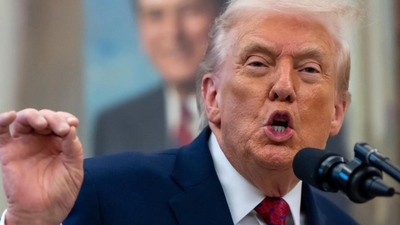
US President Donald Trump (Photo credit: AP)
US President Donald Trump on Monday filed a defamation lawsuit against the BBC, accusing Britain’s public service broadcaster of misleadingly editing a speech he delivered to supporters in Washington on January 6, 2021, shortly before the US Capitol was stormed.
The January 2021 attack on the US Capitol sought to block Congress from certifying Joe Biden’s victory in the 2020 presidential election. Trump has repeatedly denied responsibility for the violence.According to Reuters, the lawsuit was filed in federal court in Miami. Trump has alleged that edited clips aired by the BBC falsely suggested he urged supporters to storm the Capitol, causing him serious reputational and financial damage.Trump claims the broadcaster stitched together excerpts from different parts of his speech including remarks urging supporters to march to the Capitol and another in which he said “fight like hell” — while excluding a passage calling for peaceful protest. He argues that the edit created a misleading impression of a direct call for violence.
BBC’s response so far
The BBC did not immediately respond to a request for comment on the lawsuit, according to The Guardian.
However, the broadcaster has previously apologised, conceding an “error of judgment”, and acknowledged that the edit gave a mistaken impression. It has maintained that there is no legal basis for a defamation claim.In a statement issued earlier, a BBC spokesperson said lawyers had replied to Trump’s legal notice, adding: “While the BBC sincerely regrets the manner in which the video clip was edited, we strongly disagree there is a basis for a defamation claim.”
What the edited clip showed?
The disputed clip featured in an episode of Panorama broadcast shortly before the 2024 US presidential election. The controversy triggered one of the biggest crises in the BBC’s 103-year history and led to the resignations of director general Tim Davie and BBC News chief Deborah Turness last month, The Guardian reported. The broadcaster has said it does not intend to rebroadcast the documentary on any of its platforms.According to The Guardian, the edit drawn from sections of Trump’s speech delivered almost an hour apart gave the impression that he told the crowd: “We’re going to walk down to the Capitol and I’ll be there with you, and we fight. We fight like hell.”A spokesperson for Trump’s legal team said the edited footage, aired in the run-up to the 2024 election, amounted to a “brazen attempt” to interfere in the contest. “The BBC has a long pattern of deceiving its audience in coverage of President Trump, all in service of its own leftist political agenda,” the spokesperson said.
“President Trump’s powerhouse lawsuit is holding the BBC accountable for its defamation and reckless election interference.
”The row intensified after the leak of a BBC memo by an external editorial standards adviser, which raised concerns over how the programme had been edited as part of a wider review into alleged political bias at the publicly funded broadcaster. The documentary was not aired in the United States.Trump’s lawyers argue that the BBC acted “intentionally, maliciously, and deceptively”. In the filing, Trump is seeking damages of at least $5 billion.Speaking earlier to reporters, Trump said: “We’ll sue them for anywhere between $1bn and $5bn probably sometime next week. I think I have to do it. They cheated. They changed the words coming out of my mouth,” as quoted by the BBC. In a separate interview, he said: “I think I have an obligation to do it.
If you don’t do it, you don’t stop it from happening again with other people.”Legal experts cited by Reuters say Trump faces a high legal threshold under US law. As a public figure, he must prove not only that the edit was false and defamatory, but also that the BBC knowingly misled viewers or acted with reckless disregard for the truth, given strong constitutional protections for free speech and the press.The BBC is expected to argue that the programme was substantially accurate, that its editing did not materially distort the meaning of the speech, or that Trump’s reputation was not harmed.
In the UK, defamation claims must be filed within a year of publication, a deadline that has passed for the Panorama episode which may explain why Trump has chosen to sue in the US.Trump’s lawsuit argues that the Florida court has jurisdiction because the BBC conducts “substantial” business in the state, including through its website and the BritBox streaming service, which operates in the US.The case adds to a series of legal actions Trump has brought against media organisations. While CBS and ABC have settled lawsuits with him following his 2024 election victory, the New York Times, the Wall Street Journal and an Iowa newspaper have denied wrongdoing in cases filed against them.







 English (US) ·