

 2 hours ago
5
2 hours ago
5
ARTICLE AD BOX
The clock, the visionary Johan Cruyff would sigh, is never your friend. When a team is losing, it goes against them; it sprints. When a team is winning, the hands of the clock limp. Time is constant and uniform, can be measured in seconds, minutes and hours, but the impressions it leaves on men are different, and bendable on the mood. Minutes could stagger like hours; hours could blur like minutes. Time is the cancer that is eating the soul of football, too.
It dictates games and destinies; 93:20 minutes is etched in the mind of every Manchester City supporter, or any football romantic. It was the exact moment City when Sergio Aguero’s stroke of thunder nestled in the QPR net, giving them the first taste of glory in the Premier League era, the moment a footballing giant was born. It dictates human behaviours too, and turn grown-up, mild-mannered men into irascible rogues. Like Arsenal’s Gabriel Martinelli. The Brazilian is a friendly young man who seldom finds himself in the referee’s book or the dark side of law. He is part of his club’s “Bible Brothers”.
 Yet in the sheer heat of the moment, in the rush for a statement win over champions Liverpool, in the frustration of being denied three points in an intense title race, or the disappointment that they were utterly impotent in breaking down Liverpool’s defence, he turned into another man. He shoved Liverpool’s Conor Bradley, writhing in pain on the touchline, past the touchline so that the game could resume and the league leaders could press for the winning goal. The Liverpool right back, he assumed, was feigning the injury, misconstrued as an act to eat time. Except that he was genuinely injured, was stretchered off the park and was spotted walking in crutches to the team bus. He could spend months on the rehab bed. The Brazilian winger apologised publicly and personally messaged him.
Story continues below this ad
Not to absolve Martinelli of his hare-brained logic, his act was both wild and dangerous, but an argument could be raised that how Martinelli would have known that Bradley was genuinely injured or if he were feigning. That his silliness was a product of his times; the ethos of cynicism and distrust of the era he is playing football. Wasting time, and the attendant play acting, has been nearly normalised, managers have long stopped carping or brooding over them. Every one resorts to some extent of wasting time, it has almost become a tactic. Everything, though, is context and perception. The winning (or something drawing) teams call it clever; others call it dirty.
The Martinelli shove was a symptom and not the disease. The dignified Liverpool manager Arne Slot admitted as much. “The problem for him is — and it’s a problem in general in football — that there is so much time-wasting and players pretending that they are injured in the final parts of the game, or during the game, that you can then sometimes be annoyed if you want to score a goal, you think that player is time-wasting,” he observed.
Story continues below this ad
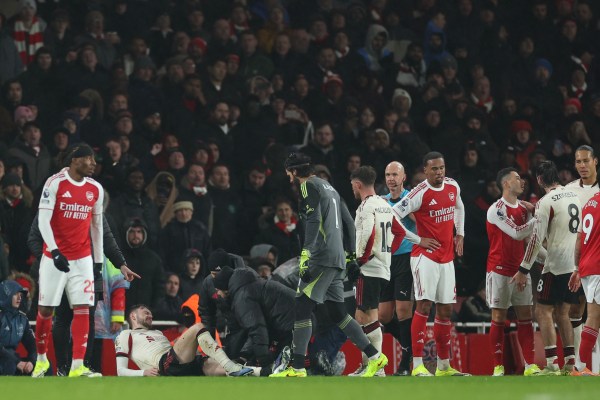 Trainers check on Liverpool’s Conor Bradley after he was injured and an ensuing altercation with Arsenal’s Gabriel Martinelli, during the Premier League match between on Thursday. (AP Photo)
The unblemished truth is that wasting time has reached an ugly and maddening level that the lawmakers could control by instructing referees to be hasher on the violations. It is too complex an element to control because the passing of time itself is a perception. For referees themselves are humans who make judgements based on the incident that has just unfolded in front of them, the fleeting time to re-run the event and arrive at a verdict. It could be shaped by his mood, homework and experience. Players, in desperate quest for points, would willingly suffer the yellow card for their club, just like the tactical fouls they make.
🗣| What Gabriel Martinelli did to the injured Bradley during the Liverpool match was honestly one of the most disgraceful moments I’ve seen this season.
A player was clearly hurt, struggling to get up, and instead of showing even the most basic human decency, Martinelli… https://t.co/2ozU24kABq pic.twitter.com/oyl7qHqB13
— Mufc Yuto (@Mufc_Yuto) January 9, 2026
The stoppage time has been extended but so have the breaks. Players, depending on the circumstances, spent more time on goal-kicks, corner kicks, throw-in, free-kicks, goal celebrations and injury-tending. So much so that despite longer stoppage times, matches in the premier league have become shorter. For instance, the last EPL season, games lasted an average of 100 minutes, yet ball-in-play time was 56 minutes and 59 seconds. This season, it has slumped to 55 minutes and five seconds. Two games this season lasted a fringe above 45 minutes, that is barely a half (Aston Villa and Bournemouth had effectively 45 minutes and 48 seconds, Newcastle-Liverpool only 45 minutes and 55 seconds). The Champions League tie between Arsenal and Slavia Prague featured only 41 minutes and 39 seconds.
Goal kicks and throw-ins are the biggest culprits. The average time lost in a match for goal-kicks in the Premier League is seven minutes and 42 seconds, or 30.4 seconds for each one. For the throw-in, it is 11 minutes and 20 seconds a game. Naturally, the flow of play is disrupted (that then is the defiant purpose of time-wasting too, to alter the balance of energy). Free-flowing football is a throwback, or an anachronism.
It has, inadvertently, become a sophisticated art. There were ample instances in the very match that would be remembered for Martinelli’s petulance. A few minutes ago, Milos Kerkez, the Liverpool left-back, was booed for spending an eternity over a throw-in. Receiving the ball, he walked backwards and sideways, looked around aimlessly, mimicked a couple of throws before actually firing the throw. It gave Liverpool ample time to realign the team’s shape. Arsenal fans soundly booed.
Damningly for the sport, time-wasting is as old as itself. No method has been found, and no cure would be discovered. Time, as Cruyff had said, is not a footballer’s friend. But the ability to waste time, slyly and artfully, is seen as a virtue in the game, fostering a win at all costs mentality than ever before.








 English (US) ·