

 10 hours ago
6
10 hours ago
6
ARTICLE AD BOX
Among those present were CPI leader Annie Raja, Swaraj India president Yogendra Yadav and economists Jean Dreze, Jayati Ghosh and Prabhat Patnaik.
Written by Nirbhay Thakur New Delhi | December 18, 2025 05:00 AM IST
 4 min read
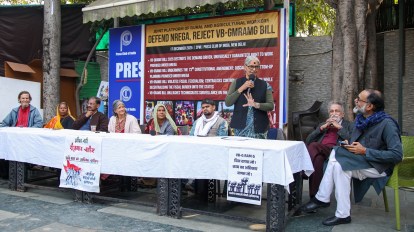 CPI leader Annie Raja, economist Jean Dreze and others during a press meet at the Press Club of India on Wednesday. (Express photo by Praveen Khanna)
A group of activists, economists, politicians and trade union leaders on Wednesday demanded that the proposed Viksit Bharat-Guarantee for Rozgar and Ajeevika Mission Gramin (VB-G RAM G) Bill that seeks to replace MGNREGA with a new law should be taken back, calling it an assault on the right to work for the poor.
Story continues below this ad
Addressing the media at the Press Club of India, the speakers said the VB-G RAM G Bill turns the guaranteed right to employment enshrined under the MGNREGA-2005 into a discretionary law controlled by the Centre. Among those present were CPI leader Annie Raja, Swaraj India president Yogendra Yadav and economists Jean Dreze, Jayati Ghosh and Prabhat Patnaik.
ARTICLE CONTINUES BELOW VIDEO
“Twenty years ago, a historic Act was brought in India. For the first time, the right to work as envisioned by the Constitution was given to the people. Today, we’re getting a new law which is diluting and finishing the provisions of the MGNREGA,” said Yadav.
Story continues below this ad
“The MGNREGA provided employment as an act of right. This cannot be undone by a mere majority. Such rights are above the majority vote. This (Bill) is reprehensible,” Patnaik, Professor Emeritus at JNU, said.
The VB-G RAM G Bill proposes to raise the number of guaranteed wage employment days in a financial year from 100 to 125 and proposes division of work into four categories — water security, rural infrastructure, livelihood infrastructure and disaster resilience. It also proposes states to bear 40% of the financial burden, a deviation from the existing arrangement when the Centre takes care of the 100% of the labour cost and 75% of the material cost. For the first time, the Bill proposes a 60-day pause during the peak agricultural seasons of sowing and harvesting, a move said to be aimed at ensuring farm labour availability.
Story continues below this ad
“They’re saying a maximum of 125 days – we all know what that means. The average days per year have been only 40 to 50. We’re likely to get much less,” said development economist Ghosh.
“You can’t make decisions like this sitting in Delhi. This is a stupid way to run a country as complicated and diverse as India… This has to be opposed as it is terrible news for federalism,” she added.
Ghosh was referring to the contentious new “normative allocation” formula which transforms the method of allocation of resources into a purely top-down process. Section 4(5) of the VB-G RAM G Bill states: “The Central Government shall determine the state-wise normative allocation for each financial year, based on objective parameters as may be prescribed by the Central Government.”
Story continues below this ad
“The GOI will have full powers to decide financial allocations, the wage rates… power to decide where and when the scheme is to be implemented,” said Dreze, former member of the UPA’s National Advisory Council, and visiting professor at the Department of Economics, Ranchi University.
“Under this Bill, the Centre has full powers and no serious obligations. All the obligations have been palmed off to state governments. Discretionary powers might be used for political purposes. All the states must fight this Bill tooth and nail,” he added.
Raja, on the other hand said that the real motive of the Bill was to provide cheap labour to capitalists and affluent farmers.







 English (US) ·