

 1 day ago
8
1 day ago
8
ARTICLE AD BOX
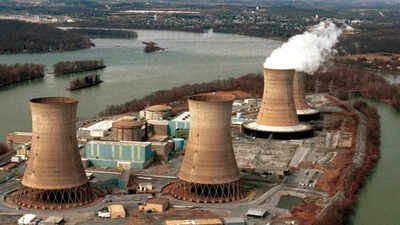
Once synonymous with fear and failure, Three Mile Island is poised for an unlikely transformation. The Pennsylvania nuclear site, home to the worst commercial nuclear accident in US history, is set to return to the grid not as a relic of the atomic age, but as a backbone for the artificial intelligence boom now reshaping the global economy.As AI data centres multiply and their appetite for electricity surges, governments and tech companies are scrambling for reliable, round-the-clock power. In the United States, that search has led policymakers back to nuclear energy and to Three Mile Island itself, where a long-shuttered reactor is now being revived to help meet the extraordinary demands of AI infrastructure.
Why AI is driving nuclear’s return
AI systems require far more electricity than traditional digital services.
Training large models and running vast data centres demands constant, high-capacity power that intermittent sources such as wind and solar struggle to provide on their own. Nuclear energy, with its ability to generate large volumes of steady, carbon-free electricity, has re-emerged as an attractive solution.Data centres already account for a growing share of US electricity use, and that figure is expected to climb sharply as AI adoption accelerates.
Energy planners increasingly see nuclear power as one of the few technologies capable of supporting this growth without worsening carbon emissions or destabilising the grid.
The Three Mile Island reboot
The revival centres on Unit 1 of the Three Mile Island facility, which was not involved in the infamous 1979 accident that crippled Unit 2. Although Unit 1 operated safely for decades afterward, it was shut down in 2019 due to economic pressures, particularly competition from cheap natural gas.Now, backed by a major federal loan and private investment, the reactor is being rebuilt and renamed the Crane Clean Energy Center. Once operational, it is expected to generate hundreds of megawatts of electricity, enough to power hundreds of thousands of homes as well as nearby AI-focused data centres.
Microsoft and the AI power deal
A key driver of the restart is a long-term power purchase agreement with Microsoft. Under the deal, the tech giant will buy electricity from the revived plant for its local data centre operations, helping to anchor the economics of the project.For Microsoft, the agreement offers a rare guarantee of reliable, carbon-free energy at scale, something increasingly difficult to secure as competition for power intensifies among AI developers. For the government and the plant’s operator, the deal ensures predictable demand over decades.
Remembering the 1979 disaster
Three Mile Island’s name still carries heavy historical weight. In 1979, a combination of mechanical failure and human error led to a partial meltdown at Unit 2, triggering widespread panic and fundamentally altering how Americans viewed nuclear power.
Although no deaths or confirmed long-term health effects were recorded, the incident led to sweeping regulatory reforms and a collapse in public trust.That legacy continues to shape debate around the plant’s return. Critics argue that reviving such a symbolically charged site risks reopening old wounds, while supporters insist that modern safety standards and decades of operational data make today’s nuclear power fundamentally different from the past.
Safety, regulation and public scepticism
Any restart requires approval from the Nuclear Regulatory Commission, which now enforces far stricter safety rules than existed in the 1970s. Supporters of the project emphasise that the revived reactor will operate under modern regulations, with upgraded systems and oversight designed to prevent the kinds of failures seen in the past.Still, public scepticism remains. For many Americans, Three Mile Island is not just a power plant but a warning from history, raising questions about whether the push to support AI is moving faster than society’s willingness to confront nuclear risk.
A signal of a broader shift
The Three Mile Island project is not an isolated case. Across the US, tech companies are striking deals with nuclear operators, and policymakers are signalling renewed support for reactors as part of a broader energy strategy. The AI boom is accelerating this shift, forcing a re-evaluation of technologies once considered politically untouchable.In that sense, Three Mile Island’s revival is emblematic of a wider recalibration. Faced with the immense power needs of AI, the United States is increasingly willing to turn to its nuclear past to fuel its technological future, even when that past is as controversial as Three Mile Island itself.








 English (US) ·