

 1 day ago
5
1 day ago
5
ARTICLE AD BOX
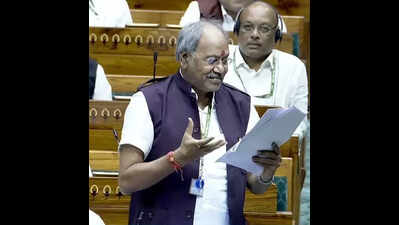
RAIPUR: If you live in Raipur, Bhilai or Korba, your city’s air just became part of a debate in Parliament.BJP MP Brijmohan Agrawal on Monday raised the issue of air pollution in India’s most polluted “non-attainment cities” (NACs), insisting that the fight for clean air must move beyond generic schemes and become science-led, city-specific action.
Bringing the focus firmly to Chhattisgarh, Agrawal specifically mentioned Bhilai, Korba and Raipur, all categorised as non-attainment cities, and said that people living in industrial and urban belts of the state deserve to be at the centre of the national public-health conversation.Speaking in Parliament, Agrawal said the worst-hit are children, the elderly, workers and vulnerable communities, and called for special protection measures for them in highly polluted zones.
He rejected the idea of a “one-size-fits-all” approach to air pollution, arguing that each city needs a location-specific, science-based, data-driven strategy. He pressed for models developed by premier institutions such as CSIR–NEERI to be integrated into regulation, and for source apportionment (SA) studies to directly shape city action plans — especially on road dust and other direct pollution sources.Responding to the concerns, minister of state for environment, forest and climate change Kirti Vardhan Singh said that under the National Clean Air Programme (NCAP), city-specific action plans, scientific studies, real-time monitoring and road-dust control measures are already showing positive results.
According to the minister, NCAP targets 122 non-attainment cities and 8 other million-plus cities, including Bhilai, Korba and Raipur. Out of 130 cities, 103 have recorded a reduction in PM10 levels, 64 have seen a drop of more than 20%, and 25 have achieved over 40% reduction.A total of 22 cities have now met the NAQS standards, with PM10 levels below 60 µg/m³, he informed the House.Agrawal, however, underlined that the issue goes beyond numbers.
“Clean air is not just an environmental concern, it is a public health question and about the secure future of coming generations,” he said, adding that it is Parliament’s duty to ensure that policies are effectively implemented on the ground and every citizen gets a clean environment.




 English (US) ·