

 1 week ago
8
1 week ago
8
ARTICLE AD BOX
According to the All India Weather Summary and Forecast Bulletin issued by the National Weather Forecasting Centre of the India Meteorological Department (IMD) on January 2, 2026, at 08:03 AM, India is set to experience an extended spell of intense winter weather, with dense fog, cold wave conditions, and rainfall or snowfall affecting several regions over the coming days.
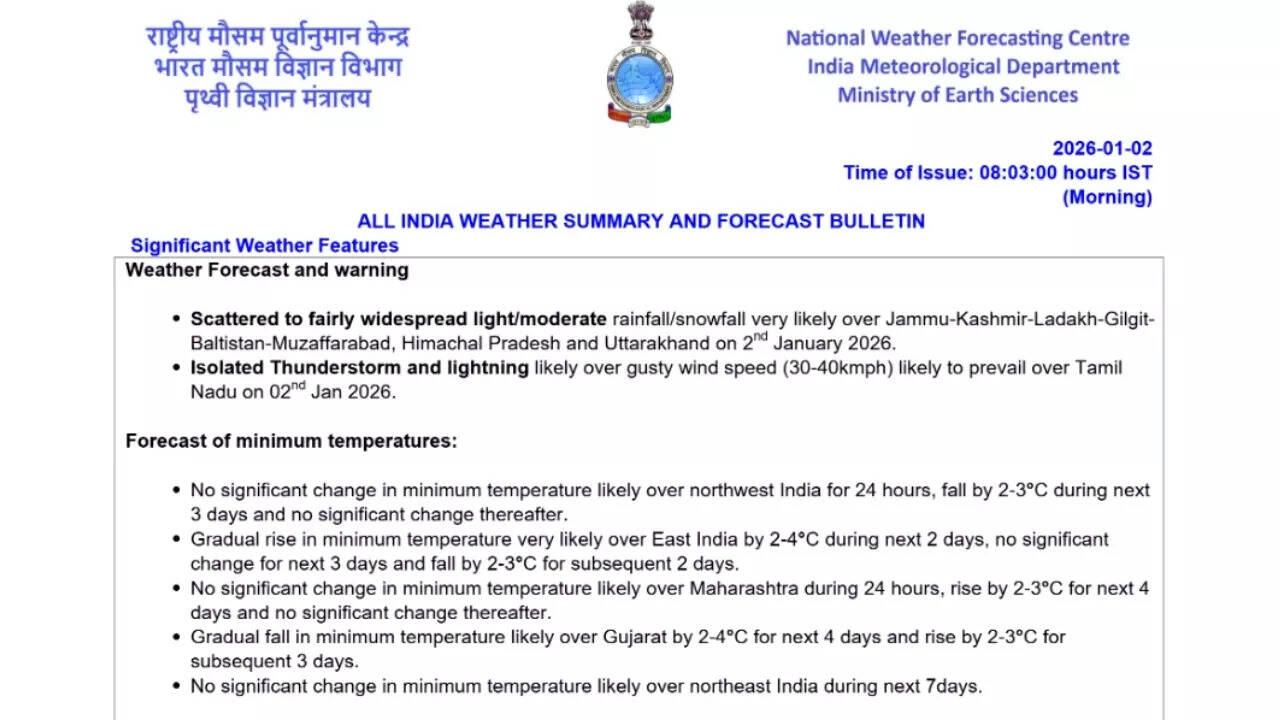
Snowfall and rain likely in the western Himalayas
According to the bulletin, scattered to fairly widespread light to moderate rainfall and snowfall over the region, Himachal Pradesh, and Uttarakhand on January 2. The ongoing snowfall in higher reaches and rainfall in lower areas may lead to slippery roads, reduced visibility, and temporary disruptions in hilly terrain.
Thunderstorms and gusty winds in southern India
In southern India, isolated thunderstorms accompanied by lightning and gusty winds with speeds of 30–40 kmph are likely over Tamil Nadu on January 2.
The IMD has attributed this activity to a persistent upper air cyclonic circulation over the southwest Bay of Bengal off the Sri Lanka coast, along with a trough extending from Lakshadweep to the Comorin area. Scattered to fairly widespread rainfall activity is also expected over Tamil Nadu and the Nicobar Islands during the coming days, bringing intermittent relief from dry conditions but also the possibility of localised disruptions.
IMD weather update
Dense fog to blanket large parts of north and east India
One of the most significant weather hazards highlighted in the bulletin is the persistence of dense to very dense fog across vast stretches of north, northwest, east, and central India. Dense to very dense fog conditions are very likely to continue during night and morning hours at many places over Punjab and Haryana, including Chandigarh and Delhi, until January 6. Similar conditions are expected over Odisha until January 5, and over Bihar and East Uttar Pradesh until January 3, with isolated pockets in Rajasthan experiencing fog till January 4.Fog conditions are also expected to extend into central and eastern India, affecting Madhya Pradesh, Chhattisgarh, Jharkhand, sub-Himalayan West Bengal and Sikkim, Gangetic West Bengal, and parts of the northeast, including Assam, Meghalaya, Arunachal Pradesh, and the states of Nagaland, Manipur, Mizoram, and Tripura, with varying durations up to January 9.The fog conditions as observed in the early morning of January 2nd show that there was dense fog at many places over Bihar as well as at most places over Himachal Pradesh.
Moderate to shallow fog was observed over Punjab, Uttarakhand, West Uttar Pradesh, Odisha, Rajasthan, and the northeast regions.
Cold wave and cold day conditions intensify
Cold wave conditions are likely to persist across several northern states over the next few days. The IMD has warned of cold wave conditions at isolated pockets of Himachal Pradesh from January 2 to 5, Punjab and Haryana, including Chandigarh and Delhi, from January 2 to 6, and Rajasthan from January 4 to 7.
Cold day conditions are also very likely at isolated places over Punjab, Haryana, Chandigarh, and Delhi on January 2, and over Bihar on January 2 and 3.
Impact on transport, power, and daily life
The IMD has cautioned that dense and very dense fog during night and morning hours may affect airports, highways, and railway routes across affected subdivisions. Poor visibility is likely to result in slower journey times and difficult driving conditions, increasing the risk of road traffic collisions unless adequate precautions are taken.
The advisory urges motorists to use fog lights, maintain safe speeds, and remain alert while travelling.People have been advised to limit outdoor exposure during peak fog hours, use protective measures where possible, and seek medical attention if respiratory or eye-related symptoms worsen. As winter conditions tighten their grip across much of the country, authorities and residents alike are urged to remain cautious, plan travel carefully, and follow advisories to minimise disruptions and health risks during the ongoing cold spell.




 English (US) ·