

 1 week ago
5
1 week ago
5
ARTICLE AD BOX
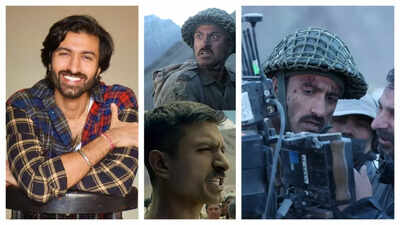
From Pine Cone to 120 Bahadur, Sahib Verma on growth, grit and the power of surrender
From intimate indie films to high-stakes action dramas, Sahib Verma’s journey as an actor has been marked by emotional range and quiet intensity. With projects like Pine Cone, Rakshak India's Braves, Hack: Crimes Online, Dillogical and the recently released 120 Bahadur, Sahib has steadily built a body of work rooted in vulnerability, introspection and transformation.
In this conversation, he reflects on his evolving artistic identity, the idea of surrender that anchors his craft, and how each role, big or small, leaves a lasting imprint on who he is, both on and off screen. Across projects you’ve explored very different worlds and emotional textures. How would you describe your artistic identity today? What connects all these performances at a deeper level for you? For me, playing any character always starts with a thought.
When you sit with something deeply, something inside you begins to shift. You start feeling a certain emotion, and your body automatically responds. You begin to live moments you’ve never lived before or sometimes, you relive moments from your own life. And that changes you a little as a person. Kabhi kabhi beech mein hi koi realisation aa jaati hai. For me, that whole process is magical.
So if there’s anything that connects all my performances, it’s the surrender and the magic that happens when you give yourself completely to a character.
You’ve moved between indie cinema, OTT narratives, and mainstream genres. What has each space taught you about the craft and what part of yourself do you feel evolves when you shift between such different storytelling ecosystems? Vaise toh, jo aap theatre mein karte ho, wahi indie, OTT, cinema sab jagah hota hai. As an actor, you’re doing the same thing: putting your heart and soul into the work. But yes, when you get a bigger platform and a bigger team, your work gets recognised even more.
That pushes you to be better. These experiences have taught me patience, to give my best, to surrender, and most importantly to truly live through the craft. Your earlier work, especially in Pine Cone, was emotionally intimate and internal, whereas Rakshak and 120 Bahadur sit in a more high-stakes, mission-driven space. How do you recalibrate your process for roles that demand such contrasting energies? I do my basic prep, of course, but detailed conversations with my director, writer, and co-actors help me immensely.
I start building the character by talking about it more and more and then I just try to live it fully with 100% belief. Again, the word is surrender.I allow things to happen, and honestly, sometimes the results surprise even me. Looking back at your journey before 120 Bahadur, was there a role or a particular set experience from these earlier projects that shifted the way you think about performance or preparation? Every role gives something back. It stays with you as a feeling, a thought, or a memory.
Like life, as your experiences change you, as an actor your characters change you too. You evolve, you learn, you start seeing things differently not just on the surface level, but much deeper, andar ki baat. All my previous roles have helped me reach here, and helped me perform the way I did in 120 Bahadur. Each of your projects explores a slightly different social or human question. Is there a theme from love to conflict to digital identity that you feel you naturally gravitate toward as an actor? Something you feel compelled to keep revisiting through your work? I’m not sure if I follow a specific pattern in the kind of roles I choose, but I do find myself always looking for the vulnerability of a character. That’s what takes me to unpredictable places, things you can’t plan or prep for. I dive into that space and trust the process, trust my writer and director, and allow myself to just be. It’s not one emotion that stays with me, but certain moments, feelings, thoughts, and memories do linger when a scene affects you deeply.
Vulnerability comes naturally to me, and when I allow myself to stay open emotionally, performing or preparing for any character becomes easier. You’ve collaborated with filmmakers who each have very distinct sensibilities from Onir’s intimate storytelling to the raw realism of action-driven narratives. Has any particular collaboration changed your approach to acting in a way that stayed with you? Onir’s film was technically my first independent feature film.
He and Ambika guided me through the process and I also just allowed myself to experience, to live. That really shaped me as an actor. Like they say things or people that affect you the most are the things/people which make your character. I think when you truly listen and surrender to the process, you learn a lot. Pine Cone was that experience for me. And with every new project, I’m just learning new people, new perspectives, new ways of seeing things.
It’s a never-ending journey. I’m sure the next scripts I pick will also teach me new things with every director I work with. You know like they say “change is the only constant.” With the industry evolving so quickly, especially on OTT, actors today often build characters through a mix of workshops, digital tools, and even personal documentation. What new methods or tools have become essential in your prep that weren’t part of your process when you started? This word will keep coming back “surrender” I started my journey with theatre in college, doing nukkad nataks and stage plays in Delhi before moving to Bombay. Later, I did a workshop with Atul Mongia and the Artist’s Collective, and that completely changed my perspective as both an actor and a human being.I was introduced to a new world: letting go, having faith, believing, living in the present, breathing. It calmed me down.
I used to be very anxious and overthink a lot. still do sometimes but this process taught me to trust whatever is happening around me and within me. Surrender has become my biggest tool. It’s something I’ll always carry with me. Whether it’s indie or mainstream, you’ve consistently been part of projects that foreground human emotion. As you look at the road ahead, what kind of stories or character complexities excite you the most? What challenges are you hoping to take on next? As an actor, you want to explore everything, every kind of story, every kind of character. There are roles that really move something inside me. I want to play a superhero, a lover boy, a cop, an army officer. Every genre excites me.But my favourite genre is drama. That’s where I feel most alive.I’m a very emotional, emotionally vulnerable person, and i dont hold back from expressing myself. And that emotional openness helps me bring depth and layers to any character.
When it comes to challenges, I never shy away. Acting is a lot like life you never know what challenges might come your way, but every challenge has a silver lining at the end of the rainbow. I’m always ready for whatever comes next. Can you tell us one of the best moments on set? I had so many memorable moments that it’s hard to pick just one. But my first day shooting a scene with Farhan Akhtar sir was something else. It was surreal.
Sharing screen space with someone I admire so much, a singer, director, actor, writer, producer, and a true inspiration is definitely a moment which is very special and I am truly grateful to have gotten this chance. I remember whenever Farhan sir came to the sets he always carried this fun energy with him which really allowed all of us to just be and live.
We really really enjoyed shooting for 120 bahadur. And this is always going to be a very special film for me. Then there were our nightly rituals: all of us “Charlie boys” gathering in my room or Ramlal’s/Ankit’s room to have haldi doodh with ghee and just unwind. And yes I met a lot of lovely people while shooting for 120 bahadur and i am glad to say that i’ve made a lot of friends there. And we all share such beautiful stories.





 English (US) ·