

 2 days ago
6
2 days ago
6
ARTICLE AD BOX
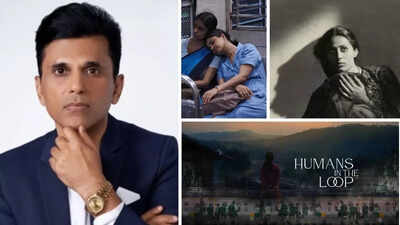
In 2024, director Payal Kapadia's film 'All We Imagine as Light' had its world premiere at the main competition of the 77th Cannes Film Festival. It was nominated for the Palme d'Or and won the Grand Prix.
In September that year, it enjoyed a limited release in Kerala and then opened nationwide in November to not just positive reviews but also substantial audience response. This was followed by a well-publicised OTT release.The same year, Shyam Benegal’s 1976 film 'Manthan' was selected for the prestigious Cannes Classics section. This was India's first-ever crowd-funded film and a compelling fictionalised account of a pioneering milk cooperative movement (Operation Flood) led by Dr.
Verghese Kurien in Gujarat. It had been a surprise hit even when it was first released. Almost 48 years later, the restored 4K version of the film not only received a standing ovation in Cannes but was also re-released in 50 cities and over 100 cinemas across India.
Indie cinema title, 'Humans in the Loop’ is an unusual Hindi-Kurukh-language drama written and directed by Aranya Sahay and explores the impact of AI (artificial intelligence) on an Adivasi woman from Jharkhand.
This film was released on a limited number of screens across major cities in September this year and subsequently premiered on Netflix.The point I am trying to make is obvious, isn't it? Despite the often-justified criticism that big-budget films monopolise screens, slowly but surely, niche films are getting their due in theatres. I am not at all suggesting that independent makers are getting enough breathing space to showcase their works at the scale that they deserve, but there is a positive shift in the right direction.I attribute this shift also to a discerning audience that has always sought a certain kind of storytelling and is now getting more access to it. Even in the seventies and early eighties, alongside action entertainers, films like 'Manthan', 'Ankur', 'Aakrosh', and 'Ardh Satya' did well in theatres. That such films need more encouragement from exhibitors and audiences goes without saying. To give you an example, a film like 'Homebound' deserved a much bigger audience.
The Neeraj Ghaywan film premiered in the Un Certain Regard section of the 2025 Cannes Film Festival and reportedly received a nine–minute standing ovation. It has also been selected as the Indian entry for the Best International Feature Film for the 98th Academy Awards, but did not fare very well in theatres at home because audiences perhaps waited to watch it on an OTT platform.
Off-beat films need very well-considered publicity campaigns.
They need to be promoted and projected on par with big-budget cinema. In Hollywood, for example, the line between thoughtful and entertaining cinema has never been too distinct. In 1977, a film made with a budget of just $1 million went on to win the Oscar. Yes, it was 'Rocky’! 2016's 'Moonlight' was made with just over $1.5 million and got the Oscar for 'Best Film' as well.
Clutter-breaking films with unconventional narratives should get funded, backed, and promoted in a way that allows them to reach their fullest potential and yet retain their creative integrity.
Recently, Paul Thomas Anderson's 'One Battle After Another', a very provocative film, became a global hit. Apart from its powerful theme, factors like the use of VistaVision for principal photography, a massive budget, and a sterling cast featuring Leonardo DiCaprio, Sean Penn, Benicio del Toro, and Regina Hall, among others, helped it to score big at the box office.
It has now grossed $191 million worldwide.As a viewer and maker, I have always been drawn to big-screen entertainers, but I remember a time when Doordarshan used to beam into our homes, films by Satyajit Ray, Mrinal Sen, and Ritwik Ghatak.
Those memories have remained with me. Today, digital streaming platforms and international film festivals have played a crucial role in showcasing niche cinema to a worldwide audience, and Oscar winning Korean film 'Parasite' perfectly exemplifies this.
I have come to believe that everyone who loves cinema should invest in a film that is striving to say something important. As an audience, we need to buy tickets to encourage such films, and if we have the resources, we should back a cinema that is independent in spirit and thought.This article has been written by Anand Pandit.







 English (US) ·