

 1 week ago
5
1 week ago
5
ARTICLE AD BOX
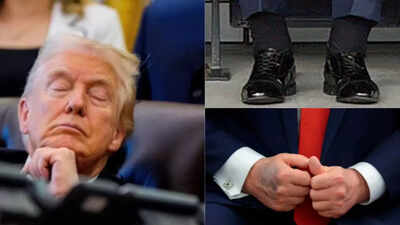
Donald Trump’s health has been under a microscope for months now. A limp in his left leg. Swollen ankles. Dark bruises on his hands. Even moments where he appeared to nod off during meetings.
Each time, the White House Press Secretary, Karoline Leavitt, and administration had tried to wave off concerns, sometimes with explanations that only fueled more questions.When the scrutiny peaked last October, Trump underwent medical imaging during his check-up at Walter Reed National Military Medical Center. At the time, it sounded straightforward. The president himself said he had an MRI. Now, he says that never happened.Speaking to The Wall Street Journal, Trump insisted the test was something else entirely. “It wasn’t an MRI,” he said. “It was less than that. It was a scan.”His physician, Navy Capt. Sean Barbabella, confirmed to the Wall Street Journal that Trump actually received a CT scan, not an MRI. A CT scan is faster and commonly used, while an MRI takes longer and provides more detailed images of soft tissue. Barbabella said doctors had told Trump they would perform either an MRI or a CT scan and ultimately chose the CT option, according to Mirror US.
According to Barbabella, the scan was done to “definitively rule out any cardiovascular issues” and showed no abnormalities. After the October check-up, both Barbabella and White House press secretary Karoline Leavitt referred to the test only as “advanced imaging,” without offering specifics.That changed later in October, when Trump told reporters aboard a flight to Tokyo that he had, in fact, received an MRI.
“I did. I got an MRI. It was perfect,” he said.By December, his answers grew fuzzier. Pressed again by reporters, Trump said he had “no idea” which part of his body was scanned. “It was just an MRI,” he said. “What part of the body? It wasn’t the brain because I took a cognitive test and I aced it.”Leavitt did not clarify why the president didn’t correct the MRI claim earlier.Now, Trump says he wishes he hadn’t taken the scan at all. “In retrospect, it’s too bad I took it because it gave them a little ammunition,” he told the Wall Street Journal.
“I would have been a lot better off if they didn’t, because the fact that I took it said, ‘Oh gee, is something wrong?’ Well, nothing’s wrong.”Since returning to the White House in January, health questions haven’t let up. In July, Trump was diagnosed with a chronic venous condition after his swollen ankles drew attention. He has also repeatedly been seen with a dark bruise on the back of his hand. Leavitt initially blamed that on frequent handshaking, while Trump has said his daily aspirin intake, which he admits is higher than typically recommended, makes his skin bruise easily.“They say aspirin is good for thinning out the blood, and I don’t want thick blood pouring through my heart,” Trump told Wall Street Journal. “I want nice, thin blood pouring through my heart. Does that make sense?”. He added, “I’m a little superstitious,” and said he has been taking aspirin for 25 years.
Can aspirin be the reason for the bruises on his hand?
Aspirin does thin blood. This can lower the risk of heart attacks and strokes by stopping the formation of blood clots.
However, it also makes bleeding easier. Thus it is also very easy to get visible bruises. Trump’s physician, Dr. Sean Barbabella, told the Journal that Trump takes 325 milligrams of aspirin each day. The Mayo Clinic notes that a low-dose aspirin typically falls between 75 and 100 milligrams, with 81 milligrams being the most commonly used, though aspirin therapy can extend up to 325 milligrams.





 English (US) ·