

 1 week ago
6
1 week ago
6
ARTICLE AD BOX
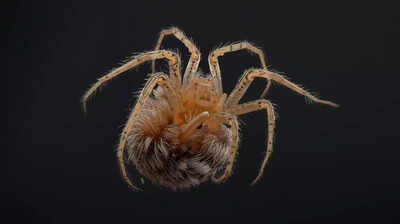
When a spider stops moving, it often finds itself tucked behind a sofa or caught in a room's corner. The legs are pulled in close, curled tight beneath the body, as if it has folded itself up.
The action feels deliberate, even though it is not intentional. For people who dislike spiders, the stillness can be more unsettling than the movement ever was. But the curled legs are neither a final pose nor a defence. They are the result of how a spider works when it is alive and how it quietly stops working when it is not. To understand it, you have to look inside the spider, at pressure rather than muscle, and at a body that relies on balance more than strength.
The legs of a dead spider always curl up due to this fluid in insects
A spider does not use paired muscles to move its legs back and forth. Instead, it relies on a mix of muscle and internal pressure. The muscles it does have are mainly for pulling the legs inward. Pushing them outward is handled by fluid.This fluid is called hemolymph. It moves through the spider’s body under pressure and acts a bit like a hydraulic system. When the spider is alive, it carefully controls that pressure to extend its legs and keep itself upright.
What happens to that pressure when a spider dies
It fades. There is no sudden snap or mechanical failure. The control simply goes away. Without active pressure pushing hemolymph into the legs, the inward pulling muscles take over by default. The legs fold in on themselves.This behaviour is not a response or a reflex. It is just gravity and physics finishing a process that used to be managed. Over time, the body can also lose stability, which is why many dead spiders end up on their backs, legs curled in tight.
Spiders do not fall apart while alive
This is due to their exceptional ability to manage pressure. That same system lets them cling to walls, grip prey, and move quickly across uneven surfaces. The lack of extensor muscles is not a weakness. It is an efficient design for an animal that weighs very little. When that control is gone, the design shows itself more clearly.
Scientists are conducting unusual experiments involving dead spiders
Scientists are conducting intriguing experiments with dead spiders. Researchers at Rice University have experimented with dead spiders by pumping air into their bodies. The legs extend again, not with life, but with pressure. Release the air and the legs curl back in.They call them spider necrobots. It sounds dramatic, but it is really just the same mechanism playing out in a different context. A reminder that even after death, the body still follows its own rules.





 English (US) ·