

 8 hours ago
3
8 hours ago
3
ARTICLE AD BOX
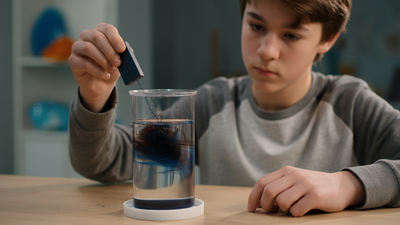
A teenager demonstrates a microplastic removal experiment, using a magnet to attract particles in water| Image Credit: TIL Creatives
Microplastics are among the hardest pollutants to explain because most people never actually see them. The particles are tiny, often invisible to the naked eye, yet they have already been detected in rivers, seawater, tap water, and bottled water across the world.
According to the World Health Organization, microplastics can enter water systems through wastewater, industrial discharge, degraded plastic waste, runoff, and even airborne deposition.The invisibility of this aspect is part of the reason why a project done by an Irish teenager named Fionn Ferreira gained so much interest globally. At only 14 years old, Ferreira invented a technique that used magnetic liquids to attract microplastics from water.
What made his innovation so revolutionary was the fact that he did not make plastic pollution disappear instantly but instead allowed people to witness it in action.A simple demonstration with a powerful imageFerreira’s experiment relied on a relatively straightforward principle. Tiny plastic particles were mixed with a magnetic liquid solution, allowing the particles to bind together before being separated with a magnet. The result created an unusually visual demonstration of contamination that is normally impossible to observe directly.
The wider scientific basis for magnetic microplastic removal has since been reinforced in peer-reviewed research. A study published in Environmental Science and indexed on PubMed found that magnetic nano-Fe3O4 particles could be used to remove several common microplastics from water. According to the study, the method was effectively applied in river water, domestic sewage, and natural seawater, where removal rates exceeded 80 percent under tested conditions.The experiment did not employ the exact procedure of Ferreira. Nonetheless, the paper showed that magnetic capture of microplastics was indeed scientifically feasible and relevant in water treatment studies. Yet another paper from the PubMed-indexed journal dealing with magnetic nanoparticles in pollutant separation discussed how magnetic separation of materials can contribute to the extraction of pollutants such as organics, inorganics, microbes, and plastics.Why the project resonated globallyEnvironmental stories may face difficulties when the harm is abstracted or distant from us. This problem did not occur in the project by Ferreira, as he managed to make a striking visual comparison between water pollution and treated water. The presence of microplastics in drinking water has already been reported in the drinking water around the globe, although it needs to be noted that many issues concerning its effects on humans have not been studied well enough.This point is crucial since the scientific community strives to avoid overstating the situation, but at the same time accepts the fact that this substance is currently incorporated into the water cycle worldwide. This project was performed at the right moment, as this topic is only now gaining popularity among people. Ferreira managed to succeed partially thanks to the fact that he offered an opportunity to touch on the issue concretely.
People would discuss the invisible contaminations of water otherwise.
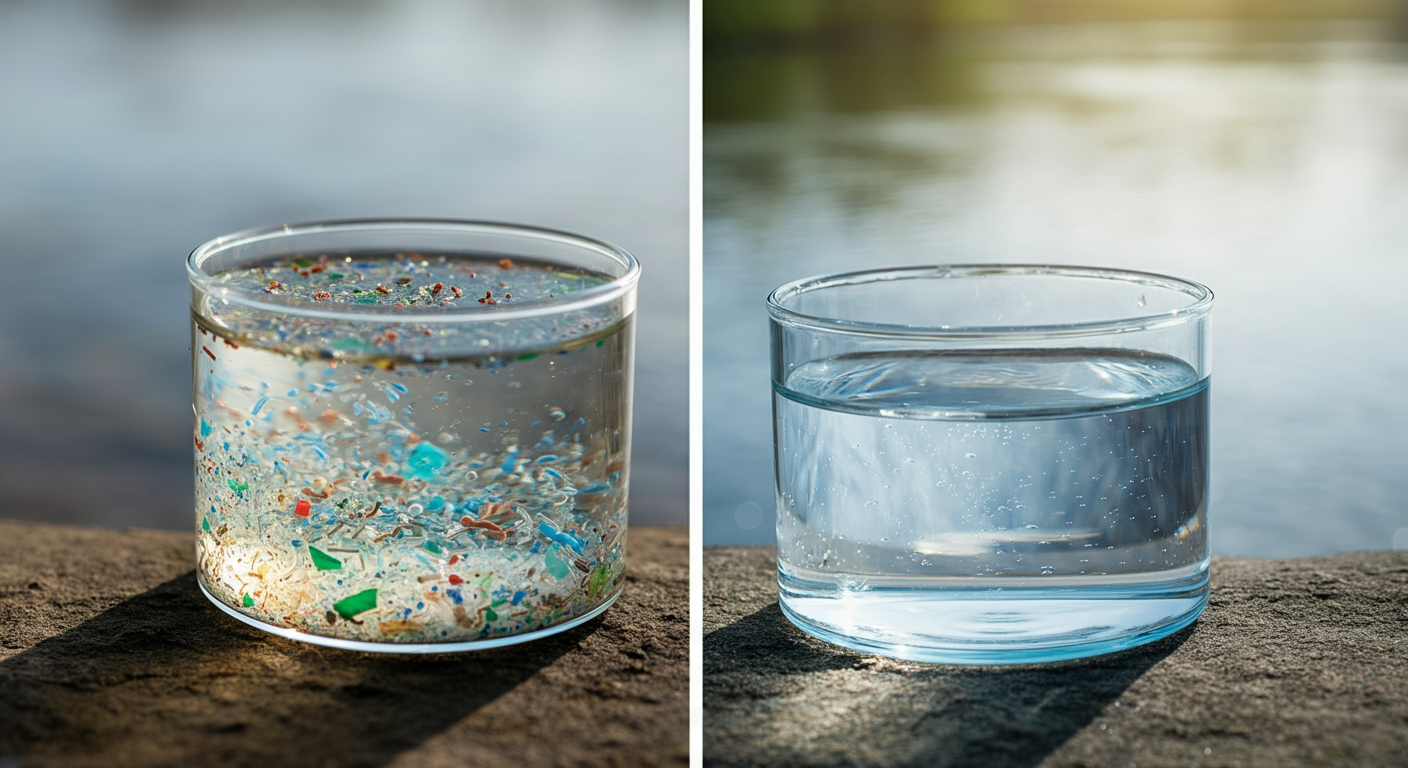
A diptych contrasting cloudy, microplastic-filled water with crystal-clear, treated water in identical containers| Image Credit: TIL Creatives
From school experiment to scientific directionEven though Ferreira’s innovation garnered attention as an adolescent invention, the overall concept belongs to the wide area of environmental engineering.Also, the material was under consideration in relation to the removal of dyes, metals, pesticides, and biological agents from water. However, Ferreira’s innovation applied a similar concept to microplastics when the topic was not yet popular in public forums.
The progress made since then has been quite extensive. In a later review that looked into magnetic and electric techniques for the removal of micro- and nanoplastics, it was observed that magnetization techniques offered hope for remediation of plastic pollution.Nonetheless, there are still challenges in terms of efficiency, sustainability, scalability, and energy consumption. This should be noted because although an invention might work successfully in the laboratory, it might not always translate well to practical use in real water treatment applications.The challenge of scaling the ideaThe distance from a great concept to viable infrastructure is quite huge. Scholars keep investigating potential materials and treatment methods, which would help get rid of microplastics efficiently in reality. Despite all the advances being made in the field, implementation seems to be a challenge.Also, the quality of wastewater treatment is not uniform across the regions of the world. Therefore, any system designed to remove microplastics needs to operate reliably in varying conditions.
This issue is among the major challenges in microplastic remediation research.Why does the story still matter?Plastic pollution was not eradicated by Ferreira's experiment, and it has never been portrayed as a cure-all measure by scientists either. The significance of the discovery does not rest here. Firstly, the project made it possible to visualize the contamination, which is hard to imagine. Secondly, it indicated the way towards the science that scientists are still investigating nowadays.Indeed, numerous water purification methods, such as magnetic, electrical, and material-based methods, are available nowadays. And Ferreira's discovery became famous because it managed to link a laboratory task and a growing global issue at a time when few people thought about this matter.In this regard, one can say that the significance of the story has a dual character – scientific and humanitarian. Indeed, a curiosity of a teenager led to the transformation of an invisible problem into a tangible one.







 English (US) ·