

 2 days ago
7
2 days ago
7
ARTICLE AD BOX
From mocking Macron's marriage to punishing India with tariffs, Trump has flipped the postwar order inside out. He is rewarding rivals, humiliating allies, and leaving the world to draw its own conclusions.
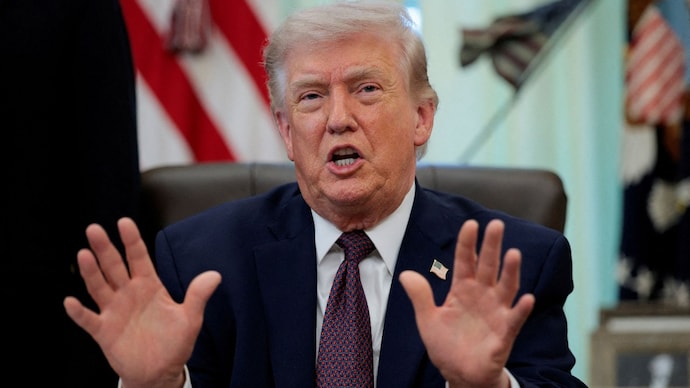
US President Donald Trump. (Photo: Reuters)
Doston se pyaar kiya, dushmanon se badla liya, jo bhi kiya humne kiya, Shaan se.
(Loved our friends, took revenge on our enemies, whatever we did, we did with pride.)
An entire generation of Indians grew up with this lyric lodged somewhere between the heart and the spine. It was more than a film song. It was a creed: love your friends, confront your enemies, and whatever you do, do it with dignity—with Shaan.
Donald Trump has learnt every single word—and inverted every single one.
In the spring of 2026, the most powerful nation on earth has turned the song inside out. Friends receive humiliation. Enemies receive embrace. And dignity—Shaan—has been replaced by fake French accents and dhobi-ghat jibes.
TRUMP’S ART OF HUMILIATING FRIENDS
There is a scene that captures this moment in Western alliance history with uncomfortable clarity. At an Easter lunch at the White House attended by government officials and faith leaders, Trump put on a fake French accent, mocked French President Emmanuel Macron’s marriage, and declared that his guest was “still recovering from the right to the jaw”—a reference to a viral video of Brigitte Macron apparently nudging her husband's face.
The room laughed. France did not. Even Macron’s fiercest political opponents rallied to his side, with hard-left lawmaker Manuel Bompard calling the remarks “absolutely unacceptable.” The centrist president of France’s National Assembly added, “We are discussing the future of the world. People are dying on the battlefield, and we have a president who is laughing, who is mocking others.”
Macron, to his credit, did not take the bait. “We must be serious,” he said from Seoul. “When we are serious, we do not say the opposite of what we said the day before.” He pointed out the central contradiction: “Six months ago, we were told everything had been destroyed and settled. Clearly, that was not the case.”
It was the sharpest possible rebuke—not personal, but surgical. A reminder that the emperor’s clothes had been visible for some time.
That same week, Trump impersonated a weak and hesitant Keir Starmer consulting his team and said the UK was “not our best” ally. This is the country that has allowed American planes to operate from British bases, whose warships are steaming toward Cyprus, and whose soldiers have died in every conflict America has called a coalition.
The mocking performance at the White House left senior diplomats telling The Guardian that the relationship was “very damaged” and may be beyond repair.
Beyond repair. That is not the language of a diplomatic disagreement. It is the language of a bridge burned so thoroughly that even the ash is gone.
THE LION, THE BULL, AND THE FOX
The Panchatantra has a story for this moment—and it is worth revisiting.
There was a powerful lion. A bull, Sanjeevaka, was his most trusted ally—strong and loyal, the one relationship that gave the lion balance and legitimacy. Together, they were formidable.
A fox had its own agenda. It flattered the lion, whispered in his ears, framed the bull’s loyalty as servility, his counsel as interference, and his very presence as a threat to the lion’s dominance. Softly. Patiently. Until the lion, convinced of his own solitary greatness, turned on the one ally he could not afford to lose.
NATO is the bull.
It is the alliance that has given American power its extraordinary reach for eight decades. It has been built on one foundational promise: an attack on one is an attack on all.
America did not build NATO out of generosity. It built it because the arrangement gave Washington unparalleled strategic depth at a fraction of the cost of going alone. Trump now wants to walk away because its members are not joining the war he started with Israel without consulting them.
Russian officials are openly revelling in Trump’s attacks, portraying them as proof of Europe’s weakness and self-sabotage. The war is shaping up as a strategic windfall for Moscow—boosting oil revenues, diverting Western attention, and straining NATO simultaneously.
The Panchatantra tells us how this ends. The lion destroys the bull with his own claws. And then, in the silence that follows, he realises—too late—what he has lost.
HURT THY ALLY
The damage to America’s eastern alliances runs just as deep.
India—a strategic partner Washington spent twenty years cultivating and a cornerstone of the Quad—was hit with punishing tariffs.
Japan, the largest foreign investor in the United States since 2019, faced “Liberation Day” tariffs of 24%, later negotiated down to 15% only after repeatedly stressing its contributions to American jobs and manufacturing.
Allies are now walking an economic tightrope simply to avoid punishment from a government that should be their natural partner.
The strategic incoherence is striking: discounts for rivals, penalties for friends.
NUKES INDISPENSABLE? THE LONG-TERM DAMAGE
Trump is not merely upending alliances—he is eroding the moral architecture built after the World War II.
That order was a response to a simple question: how do we ensure this never happens again?
For eighty years, the answer—imperfect but consequential—was American leadership and credibility.
Now, that credibility is being treated as a bargaining chip—and sometimes, a punchline.
The question being quietly asked in Seoul, Tokyo, Riyadh, Warsaw, and Berlin is chilling: should we go nuclear?
A decade ago, the question was unthinkable. Today, it is quietly gaining ground.
AN UNCERTAIN FUTURE
The comfortable classes in London, Paris, Delhi, and Tokyo want to believe this will pass.
Wait him out, they say. Trump is temporary.
But the world has now seen this twice. It knows how the interval ends.
After the 2020 election, Joe Biden reassured allies that US foreign policy had stabilised. Then Trump returned.
And that is the problem.
The issue is no longer whether NATO will survive Trump, but whether it can survive a United States that produces him—twice.
JO BHI KIYA, KIYA, SHAAN SE?
(Whatever was done, was it done with pride?)
No. Not with Shaan.
With a fake accent. A cheap joke about a man’s wife. And a smile that the Kremlin does not bother to hide.
The lion empties the forest. The fox disappears. And in the silence that follows, no one is left to sing the song.
- Ends
Published By:
Sonali Verma
Published On:
Apr 5, 2026 12:49 IST
Tune In





 English (US) ·