

 2 days ago
8
2 days ago
8
ARTICLE AD BOX
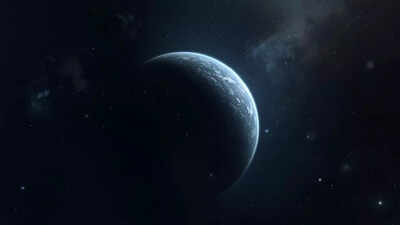
Astronomers have signalled the discovery of a planetary body roaming the Milky Way that is not gravitationally bound to the Sun or any other star. The entity is termed a free-floating planet, a class that embraces planetary mass bodies that are travelling in interstellar space independently.
These bodies do not shine in a way that is detectable and do not have the periodic signals associated with planets in orbit, hence they are hard to spot. For a long time, their existence has only been deduced from theoretical models of planetary system evolution.This finding is the first to provide direct observational evidence of a low-mass planet that is out there in the Galaxy alone, and it also gives measured constraints on its mass, movement, and surroundings in the Galactic disc.
How this rogue planet was spotted from Earth
The planet was discovered using gravitational microlensing. This is an observational technique that depends on light bending due to gravity. When a massive object comes into the line of sight from Earth to a distant background star, its gravitational field magnifies the star's light for a short time. The change in brightness that results follows a characteristic pattern, called a light curve, which depends on the mass and relative motion of the intervening object.
In this case, the recorded brightening was unusually brief, lasting only a few hours. Such a short event duration is inconsistent with stellar or brown dwarf lenses and instead points to a planetary mass body.The signal was found in a densely populated stellar field, where continuous monitoring is more likely to catch rare alignments. High cadence observations were required to resolve the rapid rise and decline of the light curve.
Follow-up imaging detected no light from the lensing object itself, indicating that it does not produce significant radiation at optical or infrared wavelengths. Modelling of the event ruled out alternative explanations, such as intrinsic variability of the background star or the presence of multiple lensing bodies.
What we know about the size of this free-floating planet
Analysis of the microlensing event allowed astronomers to estimate the planet’s mass as being comparable to that of Earth.
The estimate was derived from the timescale of the event and the inferred relative velocity between the lens and the background star. While uncertainties remain due to assumptions about distances and motion within the observed field, the data exclude masses associated with gas giant planets or low-mass stars.Crucially, no evidence was found for a host star within a wide range of possible separations. Had the planet been only loosely bound to a remote star, the gravitation of that star would have changed the shape of the microlensing light curve or caused some light to be detected in subsequent observations. The lack of such signs thus indicates that the object is a free, floating one. The findings were reported in Science, based on detailed modelling of the observational data and established microlensing theory.
How does a planet move without a Sun?
The inferred motion of the planet suggests that it is travelling through the Galactic disc rather than belonging to the stellar halo or a bound cluster. Its speed matches that of the objects, which, while having the general rotation of the Milky Way, still keep the individual motions they had from their past. Unlike planets orbiting stars, whose trajectories are dominated by local gravitational wells, free-floating planets follow paths shaped by the combined gravitational potential of the Galaxy.The available data do not allow the reconstruction of the planet’s specific origin. However, its kinematic properties are compatible with ejection from a planetary system during an early phase of dynamical instability. Gravitational interactions between forming planets can result in one body being accelerated beyond the escape velocity of its host star. Once unbound, such planets continue to orbit the Galactic centre, gradually mixing with the broader population of stars and stellar remnants.
Could there be millions of rogue planets in our galaxy?
The detection of an Earth-mass free-floating planet has implications for estimates of how many such objects exist in the Milky Way. Planet formation models have the ejection as a frequent result of the scenario of young and crowded systems, especially if there are multiple planets forming in the close vicinity. If low-mass planets are frequently expelled, the Galaxy may contain a substantial population of planetary bodies drifting through interstellar space.Microlensing surveys provide one of the few methods capable of detecting these objects directly, but they are subject to strong observational biases. Short-duration events associated with low-mass lenses are easy to miss without continuous monitoring. Each confirmed detection, therefore, carries disproportionate weight in constraining population models. As additional events are observed, it will become possible to refine estimates of the mass distribution and frequency of free-floating planets, extending empirical knowledge beyond gas giants to terrestrial mass bodies.
Why is spotting rogue planets so difficult?
Despite its utility, gravitational microlensing remains observationally demanding. Events are rare, unpredictable, and non-repeating, requiring sustained observation of millions of stars to capture a small number of usable signals. Accurate mass determinations frequently rely on additional observations, like parallax effects, which are not always obtainable. These constraints add uncertainty to the identification of individual detections.There is a plan for a survey with a better temporal coverage and a larger field of view, which will probably increase the discovery rate. In addition to that, space-based observatories and coordinated ground-based networks will enhance the sensitivity to rapidly evolving microlensing events. As datasets grow, statistical analyses will complement individual observations, allowing astronomers to characterise the population of free-floating planets more robustly.
Continued monitoring will provide further insight into the abundance and properties of these solitary planetary bodies moving through the Milky Way.Also Read | Why old books smell so good, according to science







 English (US) ·