

 5 days ago
7
5 days ago
7
ARTICLE AD BOX
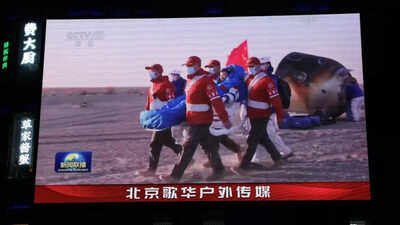
China’s Shenzhou-20 mission faced an unexpected interruption after a crack was discovered in the return capsule window, immediately before the crew was due to depart from the Tiangong space station.
The astronauts departed after a six-month mission filled with routine maintenance and experiments aboard the station. Pre-flight inspections were by the book until a fault in the pressurised cabin of the capsule was found, which led to the vehicle's integrity during re-entry being doubted. The engineers recognised that the defect was a tiny crack in the window that, although it was small, could have endangered the life-support systems.
The crew remained on the station while the issue was assessed, marking the first time a Chinese crewed spacecraft was declared temporarily unfit for return.
How minor damage revealed a major risk in orbit
The crack in the Shenzhou-20 return capsule was caused by an impact from space debris. According to the China Manned Space Agency and reporting by Reuters, the object was less than one millimetre in diameter but travelling at extreme orbital velocity. The resulting damage extended over a centimetre along the capsule window.
It was identified visually by the astronauts and corroborated by onboard monitoring systems, though standard orbital surveillance had not detected the collision in advance. The incident highlights how even microscopic debris in low Earth orbit can produce significant structural damage.
Material fatigue and stress propagation in the window were immediate concerns, and no repair could be carried out while the capsule remained attached to Tiangong.
How a tiny crack altered mission plans and the astronauts’ schedule
The discovery prompted an immediate change to Shenzhou-20’s return schedule. The crew delayed re-entry by nine days, continuing operations on Tiangong without a functional return vehicle. Mission controllers coordinated closely with engineers to ensure life-support stability and maintain the station’s operational readiness. The delay also accelerated preparations for a secondary launch. On 25 November, China executed an emergency mission, sending a replacement spacecraft to allow the astronauts a safe return.
The response demonstrated the flexibility required in human spaceflight operations, where even minor damage can affect schedules and personnel safety.
How post-landing analysis reveals orbital impacts
The Earth return of Shenzhou-20 was uncrewed for a thorough investigation. The specialists will be studying the fracture in a controlled environment and will also look at stress patterns, microfractures, and any fragments of the material. Jia Shijin, a designer of the Shenzhou spacecraft, remarked that the damage could not be fully seen from space, so an evaluation on the ground is necessary.
The results will give exact information about the impact of the micrometeoroid or debris at high speed.
The recovery is in line with standard inspection procedures for the return of crewed modules, which will enable the engineers to determine how the crack originated, how it spread, and whether the windows' structural strength might have been weakened under other circumstances.
What lessons does Shenzhou-20 offer for orbital safety?
The Shenzhou-20 accident is a reminder that space junk is still a threat that can cause serious damage.
Particles as small as a grain of sand, moving at tens of thousands of kilometres per hour, can cause much more damage than their size would suggest. When selecting materials, engineers also have to take a risk if the shield isn’t strong enough, and build redundancy into the most important systems. The crack in the window is proof that even very small space junk can affect the safety of astronauts and the continuity of the mission.
No one detected the object before the collision with the existing monitoring systems, which shows that the current debris tracking networks have their limits. The incident is a clear-cut case that prompts the community to amplify the work on slowdown and protective measures for crewed spacecraft in low Earth orbit.
How research on the capsule may guide design improvements
The return of Shenzhou-20 without a crew will be followed by an in-depth analysis. Engineers will look at the window, will examine the direction of the crack, and will identify any chemical or structural changes caused by high-velocity impacts.
All of these will be data that can help to assess risk better, decide the right materials, and find the weak points of the next spacecraft. It also points to the necessity of real-time monitoring and emergency planning.
Shenzhou-20 crew’s safety was assured thanks to the crack verification having been done in a very short time, operational adjustments being immediate, and the replacement of a vehicle being carried out without delay.
These measures have allowed the Tiangong station to carry on with its regular activities despite the accident. The incident's lessons may be used to guide changes to sensors, shielding, and emergency procedures for Chinese space missions, as well as being a source of knowledge for the spacecraft resilience community worldwide.
What Shenzhou-20 teaches about station safety
The episode emphasises how even the tiniest pieces of orbital debris that are closest to Earth can be a source of serious problems. Particles less than one millimetre in size in low Earth orbit can cause structural damage, thereby impacting safety, resource management, and scheduling. The Shenzhou-20 crew are fortunate to have remained unharmed; however, the incident is a clear demonstration that the design of spacecraft and the operational procedures should be such that they can tolerate micro-impacts at high velocity.Also Read | Can the extinct moa really be brought back to life; know the truth






 English (US) ·